
« PREVIOUS ENTRY
Nasal pilates
NEXT ENTRY »
The Worst Game Room In The World
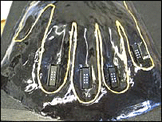
A bunch of German scientists have developed a way for mobile phones to communicate messages by touch: A set of pins that rises and falls would transmit information, kind of like braille. They don’t actually use braille, mind you. Their system is intended to communicate simple types of messages to a mobile phone user, so that they could receive messages on the sly. If you were in a meeting, you wouldn’t need to actually pull out your phone and look at it — you could just stick your hand in your pocket, feel your phone, and figure out that your spouse was texting you. As the BBC reports:
For instance, the ‘@’ sign might feel like a spiral, the word ‘I’ as a wave that flows towards the person and ‘you’ as a wave that flows away.
I love this idea. It’s part of the (hopefully) growing trend towards “ambient information” — devices that communicate information in the peripheries of our attention, as opposed to forcing us to stare at a screen. If you’ve ever seen the Ambient Orb — produced by the insanely brilliant David Rose and his team at Ambient Devices — you know what I’m talking about. Indeed, one of the most elegant pieces of ambient-information design I’ve seen are the psychoacoustics of America Online’s Instant-Messaging application. When someone on your buddy list logs on, you hear the sound of a door creaking open; when they leave, the door slams shut. It’s a delightfully nonintrusive way to let you know that your virtual social-scene is filling up, without forcing you to continually click over to look at your buddy list.
A well-designed “touch and read” mobile phone could do the same thing: When you idly reached into your pocket to touch it, it could gently indicate some important information, without you needing to whip it out and stare at it.
I'm Clive Thompson, the author of Smarter Than You Think: How Technology is Changing Our Minds for the Better (Penguin Press). You can order the book now at Amazon, Barnes and Noble, Powells, Indiebound, or through your local bookstore! I'm also a contributing writer for the New York Times Magazine and a columnist for Wired magazine. Email is here or ping me via the antiquated form of AOL IM (pomeranian99).
ECHO
Erik Weissengruber
Vespaboy
Terri Senft
Tom Igoe
El Rey Del Art
Morgan Noel
Maura Johnston
Cori Eckert
Heather Gold
Andrew Hearst
Chris Allbritton
Bret Dawson
Michele Tepper
Sharyn November
Gail Jaitin
Barnaby Marshall
Frankly, I'd Rather Not
The Shifted Librarian
Ryan Bigge
Nick Denton
Howard Sherman's Nuggets
Serial Deviant
Ellen McDermott
Jeff Liu
Marc Kelsey
Chris Shieh
Iron Monkey
Diversions
Rob Toole
Donut Rock City
Ross Judson
Idle Words
J-Walk Blog
The Antic Muse
Tribblescape
Little Things
Jeff Heer
Abstract Dynamics
Snark Market
Plastic Bag
Sensory Impact
Incoming Signals
MemeFirst
MemoryCard
Majikthise
Ludonauts
Boing Boing
Slashdot
Atrios
Smart Mobs
Plastic
Ludology.org
The Feature
Gizmodo
game girl
Mindjack
Techdirt Wireless News
Corante Gaming blog
Corante Social Software blog
ECHO
SciTech Daily
Arts and Letters Daily
Textually.org
BlogPulse
Robots.net
Alan Reiter's Wireless Data Weblog
Brad DeLong
Viral Marketing Blog
Gameblogs
Slashdot Games

