
« PREVIOUS ENTRY
Little voice
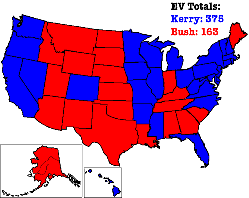
In the wake of my recent posting about the politics of map-making in the recent election, Barry Ritholt sent me an interesting collection of maps he’s been gathering, representing different slices of data — including population densities, how previously-slave-owning states voted versus non-slave-owning ones, and tax transfers (i.e. how taxes from the blue states props up the fragile, dying economies of the red states).
But the most interesting map of all? How youth voted. That map above shows who would have been elected had the election been decided solely by people age 30 and under — and it is, of course, Kerry by a landslide. After making a big hullaballoo about the importance of this year’s youthquake, hipster activists were a bit chagrined to discover that the percentage of the electorate that were young remained at 17 per cent, precisely the same as in 2000. It’s not that the youth vote did not increase in size. In fact, it grew: About 20.9 million Americans under 30 voted this time around, about 51.6 per cent of those eligible; that’s 4.6 million more than in the last election, when only 42.3 per cent of eligible young voters went to the polls. The problem is, while the youth vote went up, so did the amount of voters in every other age bracket, meaning that youth’s overall percentage of the national vote stayed the same.
Still, it’s worth looking at that map and pondering what the future holds. This is not to say that as today’s young voters age, they’ll remain the same ideologically; they could well become more conservative with age. And, as an intriguing study by the JFK School of Government recently discovered, college-age voters have a complex stew of driving forces, ranging from religion to cultural pluralism.
I'm Clive Thompson, the author of Smarter Than You Think: How Technology is Changing Our Minds for the Better (Penguin Press). You can order the book now at Amazon, Barnes and Noble, Powells, Indiebound, or through your local bookstore! I'm also a contributing writer for the New York Times Magazine and a columnist for Wired magazine. Email is here or ping me via the antiquated form of AOL IM (pomeranian99).
ECHO
Erik Weissengruber
Vespaboy
Terri Senft
Tom Igoe
El Rey Del Art
Morgan Noel
Maura Johnston
Cori Eckert
Heather Gold
Andrew Hearst
Chris Allbritton
Bret Dawson
Michele Tepper
Sharyn November
Gail Jaitin
Barnaby Marshall
Frankly, I'd Rather Not
The Shifted Librarian
Ryan Bigge
Nick Denton
Howard Sherman's Nuggets
Serial Deviant
Ellen McDermott
Jeff Liu
Marc Kelsey
Chris Shieh
Iron Monkey
Diversions
Rob Toole
Donut Rock City
Ross Judson
Idle Words
J-Walk Blog
The Antic Muse
Tribblescape
Little Things
Jeff Heer
Abstract Dynamics
Snark Market
Plastic Bag
Sensory Impact
Incoming Signals
MemeFirst
MemoryCard
Majikthise
Ludonauts
Boing Boing
Slashdot
Atrios
Smart Mobs
Plastic
Ludology.org
The Feature
Gizmodo
game girl
Mindjack
Techdirt Wireless News
Corante Gaming blog
Corante Social Software blog
ECHO
SciTech Daily
Arts and Letters Daily
Textually.org
BlogPulse
Robots.net
Alan Reiter's Wireless Data Weblog
Brad DeLong
Viral Marketing Blog
Gameblogs
Slashdot Games

