
« PREVIOUS ENTRY
Sorry for no postings
NEXT ENTRY »
The tailor as hacker
Last week, a report in Neurology outlined some rather disturbing findings: Apparently, supposedly “minimally conscious” brain-injury patients may be far more conscious than we realize. The scientists located two men who’d suffered terrible brain injuries, leaving them able to breathe on their own but otherwise unresponsive. Then the played them audiotapes of their loved ones relating cherished stories from their past. The result? The men’s brain activity was amazingly close to that of “normal”, fully-conscious people — and one of the men even had high levels of visual-cortex activity, indicating that he was perhaps visualizing the memories. If this study holds water, we may need to radically rethink how we deal with the minimally conscious — who are often abandoned and left with almost no stimulus.
Better yet, is there any way to communicate with them? This is the subject I tackled in my latest Slate column, where I looked at the state of “brain computer interfaces”. An example:
One promising technique for unlocking the thoughts of paralyzed patients is to hook them up to electroencephalograms. EEGs read the electrical impulses caused by brain activity, including the “P300 wave,” something like an involuntary “aha” response. When you’re looking at a set of items and see something you suddenly recognize, your brain automatically kicks out an electrical spike 300 milliseconds later. You don’t have to think about it; it just happens.
Psychologists Lawrence Farwell and Emanuel Donchin have turned this response into a rudimentary typing machine. The patient gets hooked up to an EEG, then looks at a computer screen that shows a six-by-six grid of the letters of the alphabet. When he focuses on a certain letter, the computer begins highlighting each column. As the column containing the chosen letter comes up, the subject’s brain spits out a P300 “aha” response. When the computer repeats the same thing with the rows and gets another “aha,” it gets the X and Y coordinates for the correct letter. Using this technique, people with ALS can “type” about four letters per minute. Best of all, because the “aha” response happens automatically, they don’t have to learn any new skills.
You can read the rest of the piece online here for free — and if you’ve any thoughts on it, feel free to post in The Fray, Slate’s comment area, where intelligent discussion is always welcome!
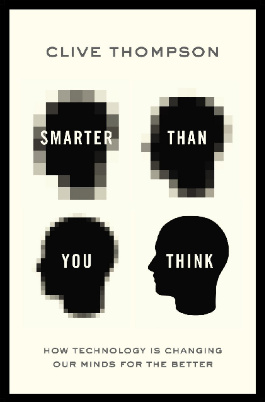
I'm Clive Thompson, the author of Smarter Than You Think: How Technology is Changing Our Minds for the Better (Penguin Press). You can order the book now at Amazon, Barnes and Noble, Powells, Indiebound, or through your local bookstore! I'm also a contributing writer for the New York Times Magazine and a columnist for Wired magazine. Email is here or ping me via the antiquated form of AOL IM (pomeranian99).
ECHO
Erik Weissengruber
Vespaboy
Terri Senft
Tom Igoe
El Rey Del Art
Morgan Noel
Maura Johnston
Cori Eckert
Heather Gold
Andrew Hearst
Chris Allbritton
Bret Dawson
Michele Tepper
Sharyn November
Gail Jaitin
Barnaby Marshall
Frankly, I'd Rather Not
The Shifted Librarian
Ryan Bigge
Nick Denton
Howard Sherman's Nuggets
Serial Deviant
Ellen McDermott
Jeff Liu
Marc Kelsey
Chris Shieh
Iron Monkey
Diversions
Rob Toole
Donut Rock City
Ross Judson
Idle Words
J-Walk Blog
The Antic Muse
Tribblescape
Little Things
Jeff Heer
Abstract Dynamics
Snark Market
Plastic Bag
Sensory Impact
Incoming Signals
MemeFirst
MemoryCard
Majikthise
Ludonauts
Boing Boing
Slashdot
Atrios
Smart Mobs
Plastic
Ludology.org
The Feature
Gizmodo
game girl
Mindjack
Techdirt Wireless News
Corante Gaming blog
Corante Social Software blog
ECHO
SciTech Daily
Arts and Letters Daily
Textually.org
BlogPulse
Robots.net
Alan Reiter's Wireless Data Weblog
Brad DeLong
Viral Marketing Blog
Gameblogs
Slashdot Games

