
« PREVIOUS ENTRY
Great bowls of fire
NEXT ENTRY »
Shrunq: a better mobile-phone browser
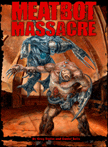
Last year, board-game designers Greg Stolze and Daniel Solis decided to create a title called Meatbot Massacre — a tongue-in-cheek, dice-rolling bit of tactical play. Since the board-game industry has notoriously tiny profit margins, they realized that they could make a lot more money — and produce a much less expensive game — by distributing it online as a downloadable PDF instead of trying to go the traditional route, publishing it in a box to sell at stores.
The problem was piracy. If you publish your game as a PDF, it’s really easy for people to simply pass it around without paying you a dime. What to do?
Re-engineer the entire concept of publication, that’s what! Last December, Stolze and Holis invented what they call “the ransom model”. It works like this: They described the basic gist of the game on their web site, and set a ransom of $600 for it. If they received $600 in donations by September 2005, they would finish creating the game — and then release it on their site, for anyone to download for free. (If they didn’t get the full $600 in time, they would donate whatever money they’d received to a homeless shelter.) As they explained, the ransom model is a win-win for lots of reasons:
First off, it makes piracy a non-issue: As soon as the property is available to anyone, it’s free for everyone. Secondly, it keeps the prices reasonable for the buyer, by definition. From where I sit, there is no conceivable way anyone can feel ripped off with this setup, since no one is being asked to front more than they’re comfortable spending.
And it worked. In only four months, Stoltze and Solid got the full $600 they asked for, and now anyone can freely download the game from their site.
It’s a fascinating concept, and reminds me of how publishing used to work back in the 19th and early 20th century. Many small presses used a subscription model: They’d announce a new book and ask for pre-paid orders. That way, they knew precisely how big (or small) their print run would be; presumably, they could also simply cancel the whole affair if they didn’t get enough interest.
It’s interesting to speculate on whether other forms of piracy-prone entertainment — such as music or small, indie video-games — could also use the ransom model. Obviously, it would only work if the artist already had a decent following, because you need people who are sufficiently devoted to you to put money up front. One example might be my friend Chris Allbritton, who spent a year blogging at Back To Iraq.com, and then announced that he wanted to finance an independent reporting trip the country: His fan base donated him $13,000 for the trip.
Stolze and Solis posted a timeline of how their donations came in, and noted that their biggest surge occurred right after they posted some samples of the colored artwork from the game in progress. Their advice to anyone using the ransom model is to “update your preview materials on a regular basis”, since it helps show people just how cool the final work will be. One could imagine that technique working neatly with an album: The artist could post some snippets, rough cuts, or individual tracks as they work towards the final song.
Regardless of whether the ransom concept would work for other media, the really cool thing here is that when these guys were faced with the prospect of piracy, they didn’t respond by suing their fans or imposing unworkable digital-rights solutions. They simply set about creating a new business model. That’s worth remembering the next time that music, movie and TV executives tell us that downloading is going to kill them. If their business models are failing, why aren’t they innovating new ones too?
(Thanks to Erik at Roll the Bones for this one!)
I'm Clive Thompson, the author of Smarter Than You Think: How Technology is Changing Our Minds for the Better (Penguin Press). You can order the book now at Amazon, Barnes and Noble, Powells, Indiebound, or through your local bookstore! I'm also a contributing writer for the New York Times Magazine and a columnist for Wired magazine. Email is here or ping me via the antiquated form of AOL IM (pomeranian99).
ECHO
Erik Weissengruber
Vespaboy
Terri Senft
Tom Igoe
El Rey Del Art
Morgan Noel
Maura Johnston
Cori Eckert
Heather Gold
Andrew Hearst
Chris Allbritton
Bret Dawson
Michele Tepper
Sharyn November
Gail Jaitin
Barnaby Marshall
Frankly, I'd Rather Not
The Shifted Librarian
Ryan Bigge
Nick Denton
Howard Sherman's Nuggets
Serial Deviant
Ellen McDermott
Jeff Liu
Marc Kelsey
Chris Shieh
Iron Monkey
Diversions
Rob Toole
Donut Rock City
Ross Judson
Idle Words
J-Walk Blog
The Antic Muse
Tribblescape
Little Things
Jeff Heer
Abstract Dynamics
Snark Market
Plastic Bag
Sensory Impact
Incoming Signals
MemeFirst
MemoryCard
Majikthise
Ludonauts
Boing Boing
Slashdot
Atrios
Smart Mobs
Plastic
Ludology.org
The Feature
Gizmodo
game girl
Mindjack
Techdirt Wireless News
Corante Gaming blog
Corante Social Software blog
ECHO
SciTech Daily
Arts and Letters Daily
Textually.org
BlogPulse
Robots.net
Alan Reiter's Wireless Data Weblog
Brad DeLong
Viral Marketing Blog
Gameblogs
Slashdot Games

