
« PREVIOUS ENTRY
The Kraken wakes, pt. 2
NEXT ENTRY »
77230: The postal code for Katrina evacuees
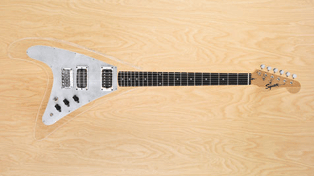
In the current issue of Wired magazine, I wrote a feature about the “fab revolution” — the advent of cheap, easy-to-use tools for crafting physical objects, such as laser cutters and 3D milling machines. Essentially, I argue that the physical world is about to become as flexible as information. Just as computers and the Internet made bits infinitely malleable, precision-guided fab tools will make atoms easy to tweak.
To explore this idea, Wired told me to fab something using eMachineshop, a company that will take anything you design in their 3D CAD software and print a physical copy of it. Since I’ve played electric guitar since I was a teenager, I decided to design and print one. Because eMachineshop doesn’t allow you to fab chunks of wood thick enough to make a guitar, I opted to create it out of clear acrylic — kind of like a big-hair metal-band guitar from the 80s — with an unfinished aluminum pickguard. (That’s it, pictured above!)
A fun concept, but as I discovered, the art of design ain’t easy. When I visited eMachineshop to pick up the body …
At first, I’m amazed that the damn thing even exists. I’ve seen it only as a virtual object, so there’s something surreal about its abrupt teleportation from my imagination to reality. Then I realize with relief that it looks kind of cool. The clear acrylic gleams like an otherworldly brick, and the brushed aluminum has precisely the sort of industrial flavor I’d hoped for. When I lay the pickguard down on the body, every hole for the pickups and electronics is precisely where I’d specified.
There’s only one problem. “It’s kind of heavy, isn’t it?” Lewis asks delicately. He’s right. Worried that the acrylic wouldn’t be strong enough to sustain deep milling, I’d made the guitar body far thicker than I should have. When I pick it up, I realize with horror that it’s much heavier than a conventional guitar. I’m going to give myself spinal damage trying to play this thing.
You can read the entire story online for free here — though I’d also recommend you buy a print copy of the issue, because it’s got a extraordinarly cool collection of other stories.
I’m on the road now, but when I get back I’ll record some audio from the guitar to blog!
I'm Clive Thompson, the author of Smarter Than You Think: How Technology is Changing Our Minds for the Better (Penguin Press). You can order the book now at Amazon, Barnes and Noble, Powells, Indiebound, or through your local bookstore! I'm also a contributing writer for the New York Times Magazine and a columnist for Wired magazine. Email is here or ping me via the antiquated form of AOL IM (pomeranian99).
ECHO
Erik Weissengruber
Vespaboy
Terri Senft
Tom Igoe
El Rey Del Art
Morgan Noel
Maura Johnston
Cori Eckert
Heather Gold
Andrew Hearst
Chris Allbritton
Bret Dawson
Michele Tepper
Sharyn November
Gail Jaitin
Barnaby Marshall
Frankly, I'd Rather Not
The Shifted Librarian
Ryan Bigge
Nick Denton
Howard Sherman's Nuggets
Serial Deviant
Ellen McDermott
Jeff Liu
Marc Kelsey
Chris Shieh
Iron Monkey
Diversions
Rob Toole
Donut Rock City
Ross Judson
Idle Words
J-Walk Blog
The Antic Muse
Tribblescape
Little Things
Jeff Heer
Abstract Dynamics
Snark Market
Plastic Bag
Sensory Impact
Incoming Signals
MemeFirst
MemoryCard
Majikthise
Ludonauts
Boing Boing
Slashdot
Atrios
Smart Mobs
Plastic
Ludology.org
The Feature
Gizmodo
game girl
Mindjack
Techdirt Wireless News
Corante Gaming blog
Corante Social Software blog
ECHO
SciTech Daily
Arts and Letters Daily
Textually.org
BlogPulse
Robots.net
Alan Reiter's Wireless Data Weblog
Brad DeLong
Viral Marketing Blog
Gameblogs
Slashdot Games

