FREE counter and Web statistics from sitetracker.com
collision detection
content | discontent
send me yours
November 29, 2005
Are smarter people better at ignoring things?


People frequently complain that they can't remember things -- and they wish their brains had more storage capacity, like today's ever-expanding computer hard drives and RAM. If we could just improve the sheer size of our memory, we'd be able to retain and manipulate more data, and we'd become smarter and smarter -- right?

Not according to an intriguing new experiment by brain scientists at the University of Oregon. Edward Vogel and a team of students took a handful of volunteers and tested their "visual working memory" -- their ability to maintain awareness of events and objects around them. The test asked them to pay attention to red or blue bricks in a visual picture.

Now, visual working memory is highly correlated to intelligence: People with a bigger VWM tend to score much better on an array of cognitive challenges. For years, scientists have assumed that VWM is roughly analogous to cramming info into your head: The more you can fit in there, the smarter you are.

But when Vogel mapped the brain-wave activity of the volunteers, he noticed something much weirder. The people with the largest capacity in their VWM weren't retaining tons of information. No, they were being quite selective. Their genius lay in being able to strip out inessential information: To pay attention only to the red bricks -- to hold only those "in mind" -- and to ignore the blue ones. The upshot, as the editors at Nature summarize, is that ...

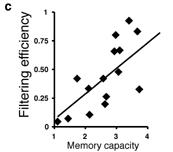
... this also implies that an individual's effective memory capacity may not simply reflect storage space, as it does with a hard disk. It may also reflect how efficiently irrelevant information is excluded from using up vital storage capacity.

That chart above shows this relationship: The more efficiently the subjects' brain worked, the bigger their memory capacity. This is not to say that people who can't screen out stimuli are dumber. As Vogel noted, "Being a bit scattered tends to be a trait of highly imaginative people." The more you rattle the marbles around in your brain, the more creative new connections you make, as it were -- connections that might be lost on those focusing intently on just the red ones.


(Thanks to the Book of Joe for this one!)

Posted by Clive Thompson at November 29, 2005 05:22 PM

Trackback Pings

TrackBack URL for this entry: http://www.collisiondetection.net/mt3/mt-tb.cgi/1379

Comments

oh dear.

I'm thinking, "now, what does this say about us bloggers?"

Posted by: yish [TypeKey Profile Page] at November 30, 2005 7:05 AM

Heh.

Posted by: Clive [TypeKey Profile Page] at November 30, 2005 11:49 AM

whoa... that is a really interesting article. But I'm not sure, is there a way to be more intelligent (in light of the information here)?

Posted by: miscblogger [TypeKey Profile Page] at November 30, 2005 7:57 PM

I've been practicing stripping out all non-essential material from my brain for years... sadly, I started by dropping most of my long term memory. So I seem to be splitting the difference. In general, if it ain't in my powerbook and it ain't right in front of me, it probably doesn't exist. sigh.

Posted by: johntunger [TypeKey Profile Page] at November 30, 2005 8:23 PM

This reminds me of some stuff I read a while back about how it turned out to be harder than expected to create computers/computer programs that could play chess at the level of a human master. At first they thought it was just a question of number-crunching--just considering all possible moves and choosing the best one--but it's actually more complicated than that.

The thing that reminded me of this, of course, is just the idea of being selective, and stripping out the inessential information. I believe that's something like what a chess master does when considering a chess board--there are a lot of possible moves there, but you're not even going to consider the majority of them.

Or am I completely off track here?

Posted by: Stephen Stralka [TypeKey Profile Page] at November 30, 2005 9:03 PM

No, you're not completely off track Stephen. There are some differences though. Chess-masters don't crunch numbers the way one might imagine, rather they have built up such experience with it that they literally 'see' the board differently, in effect, reducing the number of possible moves they need to examine, because they are familiar with the outcomes of many of the and can filter out useless/unhelpful options. Or so I suspect. The point is that their knowledge base of chess enables them to be more selective about what possibilities they examine, rather than looking at every possible move.

This isn't necessarily the case for the phenomenon described here. This visual short term memory effect is brain activity - not a cognitive process. Based on my familiarity with the task, and the waves, I suspect that this is in no way under the control of the individuals (well, except for that they are attempting to perform the task in a certain way).

I really love Vogel's stuff because these are neural markers of a cognitive processes (memory) that doesn't seem to be influenced by how people are trying to use them. That is, they seem to be built into our neural-architecture.

So while we'd like to say that these individuals are stripping away the irrelevant information, I don't believe this is something that is willed by the Cartesian mind within the brain - rather it's probably a product of the brain itself.

So, to answer your question miscblogger, I don't think there's a way to make yourself more intelligent form this. Unless they discover some substance (like coffee) has an effect on this specific neural activity.

Posted by: Steve E. [TypeKey Profile Page] at November 30, 2005 10:53 PM

Awesome conversation here folks. Steve E., I hope like hell they do isolate the substance that causes this neural reaction -- and I further hope that it actually is coffee.

Posted by: Clive [TypeKey Profile Page] at December 1, 2005 6:58 PM

You know, Clive, I'd rather be imaginative than be smart. If you want pure logical poweress, you got the computer, and soon AI will probably take over many human logic decisions. You've got to offer something different to survive.

Being smart is actually quite easy. But imagination is something that seems more magical, or phenomona.

Posted by: nova9 [TypeKey Profile Page] at December 2, 2005 4:07 PM

Steve, I think you're right that these effects are tough to control using brute conscious will, but there may indeed be a way to make yourself more "intelligent," as miscblogger suggested. Michael Posner, also at Oregon, has shown that repetitive computer training, at least in children, can increase scores on attention and even IQ tests.
Here's a link:
http://www.apa.org/monitor/oct03/young.html Now they just need to shape that training software into an addictive video game that's easy to swallow. Hmmm... Maybe there are already games out there that have the same effect. Someone call Steven Johnson.

Posted by: Matt Hutson [TypeKey Profile Page] at December 2, 2005 8:40 PM

Matt, the types of processes that Posner suggests can be improved by computer training all involve sustained and spatial attention. And actually, it *has* been demonstrated that other games, particularly first-person shooter games, have a similar effect. And I guess he suggests this is related to IQ increases.

In the visual short term memory task used by Vogel there is a sense in which the items in memory must be selectively attended, but the activity their measuring is directly related to the visual memory component. And come to think of it, I imagine that with repeated practice people may improve dramatically at this sort of task - with a concurrent change in their neural activity. But I still suspect that this is independent of volitional control, unlike, perhaps, changes in sustained and selective attention.

Posted by: Steve E. [TypeKey Profile Page] at December 3, 2005 12:24 PM

In other words smart people are good at deciding priorities.

Posted by: jawahar [TypeKey Profile Page] at January 27, 2006 12:26 AM

I believe it means that bloggers are, on average, a pile of stupid covered in hot, steamy, moron gravy.

Ta.

Posted by: Dissent [TypeKey Profile Page] at January 28, 2006 5:27 PM

Not that im an expert, or anything.

Posted by: Dissent [TypeKey Profile Page] at January 28, 2006 5:29 PM

The article does not make a distinction between memory *storage* and memory *recall*. We may all be capable of eidetic recall.

My wife has epilepsy and I have seen her memory recall system go up and down like a roller coaster when she has grand mal seizures. Even when she cannot recall basic facts and memories, they are still there. When she recovers, she is able to recall them again.

Posted by: bernard [TypeKey Profile Page] at January 29, 2006 9:40 PM

Found it very interesting. Keep up the good work. Thank you.online dating serivce

Posted by: Free dating services [TypeKey Profile Page] at June 21, 2006 12:30 AM

Post a comment

Thanks for signing in, . Now you can comment. (sign out)

NOTE: If you posted a comment and you can't see it -- try refreshing your browser.


Remember me?