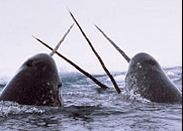
Narwhal tusks: Delicate sensing organs?

For centuries, people have made up weird explanations for why the 1.5-ton narwhal has a long, spiralled tusk. Sailors claimed the beasts wielded them in battle; Jules Verne wrote that a narwhal tusk could slice open a ship's hull "as easily as a drill pierces a barrel." Later, snake-oil merchants passed them off as unicorn horns, or ground them up and sold the powder as a cure for everything from impotence to scurvy. But the actual function of the tusk remained a mystery ...
... until now. A bunch of scientists from Harvard and the National Institute of Standards and Technology carefully studied a tusk in a lab and, as the New York Times today reports, got a shock:
The find came when the team turned an electron microscope on the tusk's material and found new subtleties of dental anatomy. The close-ups showed that 10 million nerve endings tunnel from the tusk's core toward its outer surface, communicating with the outside world. The scientists say the nerves can detect subtle changes of temperature, pressure, particle gradients and probably much else, giving the animal unique insights.
"This whale is intent on understanding its environment," said Martin T. Nweeia, the team's leader and a clinical instructor at the Harvard School of Dental Medicine. Contrary to common views, he said, "The tusk is not about guys duking it out with sticks and swords."
That's just awesome. Apparently this violates all known tooth anatomy (a sentence I did not really ever anticipate writing). Tubules in normal teeth never go to the surface. Apparently a team of Canadian scientists recently captured a live narwhal, put sensors on its head, and discovered that its brain-wave activity changes as the salinity in the water changes -- which supports the idea that the tooth is a sensing device.
There really is not enough mainstream coverage of narwhal science, if you ask me.
Posted by Clive Thompson at December 13, 2005 11:39 AM
Trackback Pings
TrackBack URL for this entry: http://www.collisiondetection.net/mt3/mt-tb.cgi/1394
Of course, you've long anticipated writing:
"There really is not enough mainstream coverage of narwhal science, if you ask me."
In any case, I'm still waiting for scientists to say,"those narwhals? No such thing. We were just messing with you. ... Whales with horns. LOL! You are such a n00b."
Posted by: A_B at December 13, 2005 1:36 PM
Posted by: Clive at December 13, 2005 2:49 PM
I love your coverage of animal science, Clive. I wish I could find more blogs with this element! It's not that I have anything against your game content, which after all was what first brought me here, but there's no shortage of game discussions out there, and there appears to be a real shortage of animal science blogs.
It occurs to me that an elongated spike with sensory apparatus is a tremendous navigation device, since it can detect variations along its length and thus provide sensitive directional data. I'm also curious about whether detecting sources of salinity variance is useful in escaping closing ice patches in the arctic, which is a challenge all artic whales face.
Posted by: Chris Bateman at December 14, 2005 3:09 AM
As far as tooth anatomy and narwhals go, try this: Imagine an Evil Dentist sandpapered the enamel off all your teeth, exposing the underlying dentin. The dentin has little channels that link directly to nerves (this is why damaged teeth are particularly sensitive to cold). Now imagine that all of your horribly exposed dental nerves were submerged in ice-cold water, all the time. And then, when you really should be writhing in agony, you instead use your teeth as a particularly subtle and precise sensory instrument to sample your environment.
That's why the scientists were so surprised.
(and yeah, this was a terrific article and Clive, I'm glad you blogged it)
Posted by: debcha at December 14, 2005 11:00 AM
Chris, glad you like it! I think the animal-science stuff originally flowed out my fascination with the oceans and the incredibly weird stuff that lives in them. And yeah, that point about the directionality of the tusk's sensitivity is very apt. I bet biomimesis would work here -- i.e. engineering an antenna with similar topography could yield some neat results.
Debbie, my mouth is now in agony merely from visualizing that scenario. Yiiiiiiiiiiii.
Posted by: Clive at December 14, 2005 11:55 AM
Here's an almost completely unhelpful comment; somewhere in Redmond O'Hanlon's excellent _No Mercy_, which relates his trip through the Congo, is a mention of some unparalleled mammal with weird teeth. Well, there's more than one such; he's a naturalist and Africa is like that. But the weird teeth I remember have channels or tubules or something in them.
Posted by: clew at December 14, 2005 3:48 PM
You can bet that my band, The Mighty Narwhale got really excited when we heard this news. And to think, before I joined the band, I thought narwhals were mythical sea creatures...they are so much cooler than unicorns.
Posted by: eyemesh at December 16, 2005 5:19 AM
Wow, both informative and entertaining. I had no idea that such a beastie even existed! Here's what the collective wisdom over at Wikipedia has to say about 'em:
Wikipedia's Narwhal page
Posted by: Rob O. at December 30, 2005 10:32 PM
Post a comment
Of course, you've long anticipated writing:
"There really is not enough mainstream coverage of narwhal science, if you ask me."
In any case, I'm still waiting for scientists to say,"those narwhals? No such thing. We were just messing with you. ... Whales with horns. LOL! You are such a n00b."
Posted by: A_B
at December 13, 2005 1:36 PM
ahahahaha
Posted by: Clive
at December 13, 2005 2:49 PM
I love your coverage of animal science, Clive. I wish I could find more blogs with this element! It's not that I have anything against your game content, which after all was what first brought me here, but there's no shortage of game discussions out there, and there appears to be a real shortage of animal science blogs.
It occurs to me that an elongated spike with sensory apparatus is a tremendous navigation device, since it can detect variations along its length and thus provide sensitive directional data. I'm also curious about whether detecting sources of salinity variance is useful in escaping closing ice patches in the arctic, which is a challenge all artic whales face.
Posted by: Chris Bateman
at December 14, 2005 3:09 AM
As far as tooth anatomy and narwhals go, try this: Imagine an Evil Dentist sandpapered the enamel off all your teeth, exposing the underlying dentin. The dentin has little channels that link directly to nerves (this is why damaged teeth are particularly sensitive to cold). Now imagine that all of your horribly exposed dental nerves were submerged in ice-cold water, all the time. And then, when you really should be writhing in agony, you instead use your teeth as a particularly subtle and precise sensory instrument to sample your environment.
That's why the scientists were so surprised.
(and yeah, this was a terrific article and Clive, I'm glad you blogged it)
Posted by: debcha
at December 14, 2005 11:00 AM
Chris, glad you like it! I think the animal-science stuff originally flowed out my fascination with the oceans and the incredibly weird stuff that lives in them. And yeah, that point about the directionality of the tusk's sensitivity is very apt. I bet biomimesis would work here -- i.e. engineering an antenna with similar topography could yield some neat results.
Debbie, my mouth is now in agony merely from visualizing that scenario. Yiiiiiiiiiiii.
Posted by: Clive
at December 14, 2005 11:55 AM
Here's an almost completely unhelpful comment; somewhere in Redmond O'Hanlon's excellent _No Mercy_, which relates his trip through the Congo, is a mention of some unparalleled mammal with weird teeth. Well, there's more than one such; he's a naturalist and Africa is like that. But the weird teeth I remember have channels or tubules or something in them.
Posted by: clew
at December 14, 2005 3:48 PM
You can bet that my band, The Mighty Narwhale got really excited when we heard this news. And to think, before I joined the band, I thought narwhals were mythical sea creatures...they are so much cooler than unicorns.
Posted by: eyemesh
at December 16, 2005 5:19 AM
Wow, both informative and entertaining. I had no idea that such a beastie even existed! Here's what the collective wisdom over at Wikipedia has to say about 'em:
Wikipedia's Narwhal page
Posted by: Rob O.
at December 30, 2005 10:32 PM