
« PREVIOUS ENTRY
Snailbot!
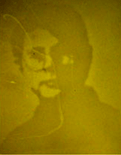
Dig this: A group of students have developed photographic film composed of bacteria. They took E. coli and genetically modified it by adding a protein from blue-green algae that detects light. They also linked it to the E. coli’s digestion: In the dark, the bacteria digest sugar and produce a black pigment, but in the light they don’t. Then they coated a petri dish evenly with this modified stuff.
The result? An organic way of taking pictures. The students put the petri dish inside a pinhole camera, expose the dish to light, and presto: The bacteria produce replicas of the scene in dark patches of pigment. As Aaron Chevalier, one of the students, told the University of Texas’ web site:
“At first, we made blobby images and you had to imagine what they were.”
But over the course of the year, he and the other students refined the camera. Although it’s still made with old bookends, discarded microscope parts and a used incubator, the newest camera is much more compact and takes crisper pictures.
I love the look of the photos: They’re like ghostly old daguerreotypes somebody found in their dead greataunt’s attic. It’s a great way to show the promise of synthetic biology — mucking with genetic material to produce new and weirdly useful forms of life.
(Thanks to Joel Collier for this one!)
I'm Clive Thompson, the author of Smarter Than You Think: How Technology is Changing Our Minds for the Better (Penguin Press). You can order the book now at Amazon, Barnes and Noble, Powells, Indiebound, or through your local bookstore! I'm also a contributing writer for the New York Times Magazine and a columnist for Wired magazine. Email is here or ping me via the antiquated form of AOL IM (pomeranian99).
ECHO
Erik Weissengruber
Vespaboy
Terri Senft
Tom Igoe
El Rey Del Art
Morgan Noel
Maura Johnston
Cori Eckert
Heather Gold
Andrew Hearst
Chris Allbritton
Bret Dawson
Michele Tepper
Sharyn November
Gail Jaitin
Barnaby Marshall
Frankly, I'd Rather Not
The Shifted Librarian
Ryan Bigge
Nick Denton
Howard Sherman's Nuggets
Serial Deviant
Ellen McDermott
Jeff Liu
Marc Kelsey
Chris Shieh
Iron Monkey
Diversions
Rob Toole
Donut Rock City
Ross Judson
Idle Words
J-Walk Blog
The Antic Muse
Tribblescape
Little Things
Jeff Heer
Abstract Dynamics
Snark Market
Plastic Bag
Sensory Impact
Incoming Signals
MemeFirst
MemoryCard
Majikthise
Ludonauts
Boing Boing
Slashdot
Atrios
Smart Mobs
Plastic
Ludology.org
The Feature
Gizmodo
game girl
Mindjack
Techdirt Wireless News
Corante Gaming blog
Corante Social Software blog
ECHO
SciTech Daily
Arts and Letters Daily
Textually.org
BlogPulse
Robots.net
Alan Reiter's Wireless Data Weblog
Brad DeLong
Viral Marketing Blog
Gameblogs
Slashdot Games

