Why cats love high-def TV

Phil Swann, the high-definition TV guru, has noticed something interesting: Cats love the super-real images on high-def TV. Back in 2001, he bought his first high-def set, and as soon as he turned it on, he got an interesting reaction from his cat, Snoopy. As Swann reports on his site:
Surfing the dial, I stumbled upon a HDTV channel that was showing a documentary on the American Bald Eagle. Snoopy was taking a cat nap in a chair to the left of the TV, but suddenly looked up and saw an eagle soaring across the screen. She immediately walked over and began watching -- and she hasn't stopped yet. [snip]
In fact, she will watch for 20 minutes at a time, particularly if the show features birds, fish or animals. If she sees a bird flying on a high-def channel, she will crouch down in the attacker stance as if the winged creature was right in front of her.
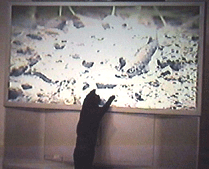
That's Snoopy above, checking out some fish. And apparently Snoopy isn't alone. When Swann posted on a discussion board, other HDTV owners said they'd seen precisely the same behavior. Obviously, pets have been avid watchers of twittering, skittering TV images for years, but the realism of HD does seem to fool pets even more. Indeed, one owner noted that his cats freak out when a Discover HD broadcat with animals come on -- but don't respond at all when Animal Planet, a non-HD broadcast, plays.
This brings to mind an interesting aesthetic question that erupted when I wrote about HDTV a few months ago. My piece noted that many famous stars look totally hideous in HD, because their previously-unnoticed imperfections -- tiny wrinkles, face-lift seams -- suddenly become glaring flaws. But all the experts I talked to noted that nature shows look fabulous. Humans in closeup wither; but nature flowers, because its beauty is fractal -- the closer you get, the more you can notice the elegant nuances of a leaf, a river, or an iguana.
Posted by Clive Thompson at January 17, 2006 01:15 PM
Trackback Pings
TrackBack URL for this entry: http://www.collisiondetection.net/mt3/mt-tb.cgi/1411
I can't wait until you need a magnifying glass to discern the finest details on a display. I was thinking about this in depth--probably from seeing an old spy movie in which a message was etched microscopically on a film slide.
There will likely be a point where the resolution of a display is higher than the discernment of a human eye. However, it will probably be postulated that displays that are "ultra-liminal" will *look* better than sub- or equi-liminal displays (much like the claim of audiophiles that even though you don't hear certain frequencies consciously, they make a difference in the final product).
I also envision most displays of the future being like paper, exactly like paper, but with editable graphics, etc. A "book" will simply be a single page/display or a collection of specialized page/displays.
Posted by: Alfred Cloutier at January 17, 2006 3:38 PM
humans closeup don't wither in general -- just their makeup and plastic surgery.
Posted by: J at January 17, 2006 6:07 PM
It occurred to me reading your earlier piece on the effect of HDTV on current stars that another unintended result of the technology could be a massive comeback for Max Headroom (hope Matt Frewer held on to the prosthetics).
Posted by: Little Mr Square Eyes at January 17, 2006 6:34 PM
I don't know how HDTV works, so I could be out to lunch here, but is it possible that the refresh rate of HDTV is different (perhaps faster) than conventional TV? I was watching a show about the physiology of dogs and it explained that dogs aren't interested in TV because they process visual stimulation faster than humans, and so TV looks very flickery to them.
Maybe it's the same way with cats.
Posted by: marc at January 17, 2006 7:18 PM
(My parents, as they approached Yosemite Falls about a year ago, overheard a small girl (of maybe 9) exclaim in appreciation: "This is awesome! It looks digital!")
Posted by: Michael S. at January 17, 2006 7:39 PM
There are a lot of ways to measure intelligence in animals - for birds they usually use a brain weight to overall weight ratio. For cats they compare the number of neurons in the optic nerve. A few years ago they showed that by this measure housecats are 400 times stupider than their nearest wild relative (a spanish wildcat, I think).
Cats, of course, have much better vision than humans. Wild cats even more so. To a tiger or lion (or a liger!), standard TV looks like a bright dot tracing across the screen because their sense of sight works faster than ours. They can see the cathode ray, but not the picture it paints. The net result of this is that housecats, by nature of being dumber (as measured by their ability to see) than their wild brethren, generally fall just on either side of the can-or-cannot-watch-tv divide. If your cat can watch standard TV it means that they're a little dumber than average. (Like mine.)
I'm not sure what sort of HDTV units they're using (plasma, LCD, rear-projection), but evidently they don't suffer from this problem meaning that more cats can perceive the picture. I'm curious to know whether or not wild cats can see HDTV.
Posted by: Jemaleddin at January 18, 2006 10:09 AM
Maybe we just need to revise our standards of beauty and realize that in reality people are beautiful, even with all their flaws.
Nah, that won't happen, will it?
Posted by: tigger at January 18, 2006 7:58 PM
marc, I think you almost hit the nail on the head. As far as I know, HDTV merely has more lines of resolution, but to make the picture look better, most HDTV displays use interlacing, so the whole image doesn't disappear like it does everytime the electron gun reaches the bottom on your regular TV. The other thing is that we have to do a tremendous amount of mental processing to fill in the fuzzy parts of a regular TV image.
Posted by: RGlasel at January 20, 2006 5:13 PM
Totally awesome conversation here.
Alfred, I once remember a Wired story with someone who was calculating the precise resolution of the actual human eye. But I can't remember the figure!
Posted by: Clive at January 22, 2006 2:57 PM
Post a comment
I can't wait until you need a magnifying glass to discern the finest details on a display. I was thinking about this in depth--probably from seeing an old spy movie in which a message was etched microscopically on a film slide.
There will likely be a point where the resolution of a display is higher than the discernment of a human eye. However, it will probably be postulated that displays that are "ultra-liminal" will *look* better than sub- or equi-liminal displays (much like the claim of audiophiles that even though you don't hear certain frequencies consciously, they make a difference in the final product).
I also envision most displays of the future being like paper, exactly like paper, but with editable graphics, etc. A "book" will simply be a single page/display or a collection of specialized page/displays.
Posted by: Alfred Cloutier
at January 17, 2006 3:38 PM
humans closeup don't wither in general -- just their makeup and plastic surgery.
Posted by: J
at January 17, 2006 6:07 PM
It occurred to me reading your earlier piece on the effect of HDTV on current stars that another unintended result of the technology could be a massive comeback for Max Headroom (hope Matt Frewer held on to the prosthetics).
Posted by: Little Mr Square Eyes
at January 17, 2006 6:34 PM
I don't know how HDTV works, so I could be out to lunch here, but is it possible that the refresh rate of HDTV is different (perhaps faster) than conventional TV? I was watching a show about the physiology of dogs and it explained that dogs aren't interested in TV because they process visual stimulation faster than humans, and so TV looks very flickery to them.
Maybe it's the same way with cats.
Posted by: marc
at January 17, 2006 7:18 PM
(My parents, as they approached Yosemite Falls about a year ago, overheard a small girl (of maybe 9) exclaim in appreciation: "This is awesome! It looks digital!")
Posted by: Michael S.
at January 17, 2006 7:39 PM
There are a lot of ways to measure intelligence in animals - for birds they usually use a brain weight to overall weight ratio. For cats they compare the number of neurons in the optic nerve. A few years ago they showed that by this measure housecats are 400 times stupider than their nearest wild relative (a spanish wildcat, I think).
Cats, of course, have much better vision than humans. Wild cats even more so. To a tiger or lion (or a liger!), standard TV looks like a bright dot tracing across the screen because their sense of sight works faster than ours. They can see the cathode ray, but not the picture it paints. The net result of this is that housecats, by nature of being dumber (as measured by their ability to see) than their wild brethren, generally fall just on either side of the can-or-cannot-watch-tv divide. If your cat can watch standard TV it means that they're a little dumber than average. (Like mine.)
I'm not sure what sort of HDTV units they're using (plasma, LCD, rear-projection), but evidently they don't suffer from this problem meaning that more cats can perceive the picture. I'm curious to know whether or not wild cats can see HDTV.
Posted by: Jemaleddin
at January 18, 2006 10:09 AM
Maybe we just need to revise our standards of beauty and realize that in reality people are beautiful, even with all their flaws.
Nah, that won't happen, will it?
Posted by: tigger
at January 18, 2006 7:58 PM
marc, I think you almost hit the nail on the head. As far as I know, HDTV merely has more lines of resolution, but to make the picture look better, most HDTV displays use interlacing, so the whole image doesn't disappear like it does everytime the electron gun reaches the bottom on your regular TV. The other thing is that we have to do a tremendous amount of mental processing to fill in the fuzzy parts of a regular TV image.
Posted by: RGlasel
at January 20, 2006 5:13 PM
Totally awesome conversation here.
Alfred, I once remember a Wired story with someone who was calculating the precise resolution of the actual human eye. But I can't remember the figure!
Posted by: Clive
at January 22, 2006 2:57 PM