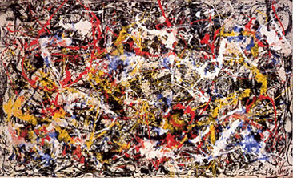
Taylor, who also has a degree in art theory, got interested in Pollock's work back in the 1990s. He suspected that Pollock's famously chaotic paintings -- created by the artist standing over the canvases and dripping paint -- displayed fractal mathematics: They had self-replicating geometry, such that the larger shapes in the picture were similar to the tiny shapes you'd see if you looked at closely the edges of the splatters. He put computer-generated grids over images of five Pollock splatter paintings and, sure enough, there they were: Two sets of fractal patterns, one that resolved on a 5 mm scale, and another on a 1 mm scale.
Cool enough, eh? Now dig this: Last year, 32 new "poured" paintings -- purportedly by Pollock -- were uncovered for the first time. Art historians have been arguing heatedly over whether they're real Pollocks, because the official Pollock authentication board was disbanded in 1995 when it was assumed there were no new Pollocks to find. One of the former members of the board is launching a new show of Pollock's work that includes some the new-found paintings; after seeing one of Taylor's papers on his Pollock-fractal work (in Pattern Recognition Letters, a just awesomely-titled academic journal), the art expert sent Taylor six of the new paintings to analyze.
His verdict? They didn't display Pollock's distinctive fractal patterns. While Taylor says his technique shouldn't be regarded as a final word on Pollock authenticity, it's a pretty nifty use of fractal math.
Posted by Clive Thompson at February 27, 2006 10:21 PM
Trackback Pings
TrackBack URL for this entry: http://www.collisiondetection.net/mt3/mt-tb.cgi/1438
I always thought something like this should be possible! Which is great, because I've sent a lot of my work out into the world unsigned (bad, bad habit).
Of course, due to the ah, recalitrant, nature of most of my materials, pretty much anything I've done can be authenticated by DNA. I don't think I've ever finished a piece without cutting myself somewhere.
Posted by: johntunger at February 28, 2006 12:33 AM
Yikes! Actually, wouldn't there be a fair amount of genetic material of the artist on almost any type of artwork -- painting, sculpture, etc? That would make it possible to do a genetic authenticity test: If you find the artist's DNA on the artwork, it was probably hers/his.
Mind you, finding and isolating enough DNA on a painting would be pretty tricky. Tons of people would have handled the painting, so oy, what a mess.
Posted by: Clive at March 1, 2006 4:52 PM
as an art student, and a big fan of Pollock, i was intrigued by this article, i came across few weeks ago.
and it seems so deeply rooted in logic, that an artist such as Pollock, specifically, could be recognized by a certain "inner" pattern such as this. beside the fact the fractal construct every thing manifested in nature, (if you look close enough) - so no wonder...beside that, Pollock after all was going in to some kind of "trans" while working, and the movements and stroke he imposed where a manifestation of his inner vocation, and inner subconscious, so the pattern and the being is decoded here.
Posted by: Moon River at March 1, 2006 5:38 PM
I think it's naive to believe that we can decode anything meaningful about JP's psyche by analyzing the fractal geometry of his paint dribblings. Maybe something about his vestibular system, but to me the particular patterns have no currency in the world of big ideas, and I would imagine to a computer they would have even less. Without appreciating the context in which they were produced (their role in the vanguard of abstract expressionism, for example), and setting aside the pure optical effects, the paintings effect no more insight than a blank canvas.
Why would it make a difference if a poured painting was done by Pollock or not? That is, assuming humans cannot tell the difference. Ah, but now I am calling into question the inspired nature of art.
Mathematically, Taylor's project is interesting. Humanistically, not so much.
Posted by: Matt Hutson at March 3, 2006 7:50 PM
Hey Moon River -- sure, the idea of a subconscious order in a Pollock painting makes intuitive sense to me too!
Matt, you're quite right that the nature of the fractals wouldn't give you any insight into the meaning of Pollock's paintings. But I don't think the scientist who developed this technique claimed that; he merely argued that the fractals were a stylistic fingerprint that would help identify a real Pollock from a fake one.
Posted by: Clive at March 6, 2006 1:31 PM
Clive, you're right. I was more trying to pick a fight with Moon River...
And you, too, it seems! Ya, I suppose it makes some intuitive sense to speak of a subconscious order to JP's paintings, but what does that mean, really? Can we make any connections between the patterns in the paintings and the structure of Pollock's subconscious? It might make a great soundbite to say that we can now fingerprint the id through fingerpaints, but it's not like the fingerprints will tell us any more than a palm reading--the reading is all in the eye of the beholder. In other words, a blank canvas prepped for whatever interpretation you want to project. (Let's see, can I mix any more metaphors in here?)
Posted by: Matt Hutson at March 6, 2006 10:06 PM
Matt Hutson, you would be surprised at the "humanistically" interesting things the subconscious can reveal.
And I am not speaking of quackery like palm reading or phrenology (racist ancestors to body-reading). This is real knowledge that we can know through the synergistic disciplines of psychoanalysis, art theory, and information technology.
For instance, Matt, did you notice you used the word "Pollock" once in your first comment, and once in your second? This, you may notice is the beginning of the famous mathematic sequence, the Fibonacci Numbers, found all over nature! You used 139 words in your first comment, and 125 in your second, with regularity indicative of (Freudian) anal retention.
Give up the fight. You and Moon River and Clive and Jackson Pollock and I are all spiritually interconnected through fractals and tessellations, and it's all expressed here in these words and in some dumb paintings that look like throw-up.
Posted by: elizabeth at March 7, 2006 12:10 AM
Posted by: Clive at March 8, 2006 12:46 PM
I always thought something like this should be possible! Which is great, because I've sent a lot of my work out into the world unsigned (bad, bad habit).
Of course, due to the ah, recalitrant, nature of most of my materials, pretty much anything I've done can be authenticated by DNA. I don't think I've ever finished a piece without cutting myself somewhere.
Posted by: johntunger
at February 28, 2006 12:33 AM
Yikes! Actually, wouldn't there be a fair amount of genetic material of the artist on almost any type of artwork -- painting, sculpture, etc? That would make it possible to do a genetic authenticity test: If you find the artist's DNA on the artwork, it was probably hers/his.
Mind you, finding and isolating enough DNA on a painting would be pretty tricky. Tons of people would have handled the painting, so oy, what a mess.
Posted by: Clive
at March 1, 2006 4:52 PM
as an art student, and a big fan of Pollock, i was intrigued by this article, i came across few weeks ago.
and it seems so deeply rooted in logic, that an artist such as Pollock, specifically, could be recognized by a certain "inner" pattern such as this. beside the fact the fractal construct every thing manifested in nature, (if you look close enough) - so no wonder...beside that, Pollock after all was going in to some kind of "trans" while working, and the movements and stroke he imposed where a manifestation of his inner vocation, and inner subconscious, so the pattern and the being is decoded here.
Posted by: Moon River
at March 1, 2006 5:38 PM
I think it's naive to believe that we can decode anything meaningful about JP's psyche by analyzing the fractal geometry of his paint dribblings. Maybe something about his vestibular system, but to me the particular patterns have no currency in the world of big ideas, and I would imagine to a computer they would have even less. Without appreciating the context in which they were produced (their role in the vanguard of abstract expressionism, for example), and setting aside the pure optical effects, the paintings effect no more insight than a blank canvas.
Why would it make a difference if a poured painting was done by Pollock or not? That is, assuming humans cannot tell the difference. Ah, but now I am calling into question the inspired nature of art.
Mathematically, Taylor's project is interesting. Humanistically, not so much.
Posted by: Matt Hutson
at March 3, 2006 7:50 PM
Hey Moon River -- sure, the idea of a subconscious order in a Pollock painting makes intuitive sense to me too!
Matt, you're quite right that the nature of the fractals wouldn't give you any insight into the meaning of Pollock's paintings. But I don't think the scientist who developed this technique claimed that; he merely argued that the fractals were a stylistic fingerprint that would help identify a real Pollock from a fake one.
Posted by: Clive
at March 6, 2006 1:31 PM
Clive, you're right. I was more trying to pick a fight with Moon River...
And you, too, it seems! Ya, I suppose it makes some intuitive sense to speak of a subconscious order to JP's paintings, but what does that mean, really? Can we make any connections between the patterns in the paintings and the structure of Pollock's subconscious? It might make a great soundbite to say that we can now fingerprint the id through fingerpaints, but it's not like the fingerprints will tell us any more than a palm reading--the reading is all in the eye of the beholder. In other words, a blank canvas prepped for whatever interpretation you want to project. (Let's see, can I mix any more metaphors in here?)
Posted by: Matt Hutson
at March 6, 2006 10:06 PM
Matt Hutson, you would be surprised at the "humanistically" interesting things the subconscious can reveal.
And I am not speaking of quackery like palm reading or phrenology (racist ancestors to body-reading). This is real knowledge that we can know through the synergistic disciplines of psychoanalysis, art theory, and information technology.
For instance, Matt, did you notice you used the word "Pollock" once in your first comment, and once in your second? This, you may notice is the beginning of the famous mathematic sequence, the Fibonacci Numbers, found all over nature! You used 139 words in your first comment, and 125 in your second, with regularity indicative of (Freudian) anal retention.
Give up the fight. You and Moon River and Clive and Jackson Pollock and I are all spiritually interconnected through fractals and tessellations, and it's all expressed here in these words and in some dumb paintings that look like throw-up.
Posted by: elizabeth
at March 7, 2006 12:10 AM
Aahahah! Excellent conversation here.
I wonder what patterns would emerge if I crunched data on all my blog postings of the last three years? Would Donald Foster be able to extract the linguistic fingerprint that would reveal the text to be mine, even if it were anonymized? Or, as per the Israeli scientists I wrote about a few years ago, does the pattern of my word usage show that I write like a woman or a man?
Posted by: Clive
at March 8, 2006 12:46 PM