
« PREVIOUS ENTRY
Dress your Roomba like a little french maid
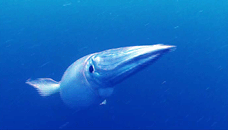
Behold the fearsome Diablo Rojo — a seven-foot-long Giant Humboldt Squid that, as legend has it, actually attacks and eats grown men.
For years, it was assumed that the lurid stories of man-eating were simply myths. A few years ago, a National Geographic diver swam with a bunch of three-foot-long Giant Humboldt Squid, and claimed they were harmless. But Scott Cassell knows better. A longtime diver and world expert on the Squid, he recently dove into the coasts off Baja and encountered — for the first time ever — a mammoth seven-footer, which he nicknamed “Scar”. Cassell wrote a fabulous (and thoroughly terrifying) essay about the encounter on the Deeper Blue website. An excerpt:
The monstrous squid remains motionless just ten feet away. Emotions gave way to cognitive thought and I trained my camcorder on him and begin to record. Almost on cue, he begins his approach. Then, with blinding acceleration, he lurches onto me with a powerful “thud crackle”. He slams into my chest. The impact was incredibly powerful, knocking the wind out of me. His huge arms envelope my complete upper body and camera and I can feel my chest plate move as his beak grinds against it. The crackle and scratching of thousands of chitenous ring teeth against my fiberglass/kevlar chest plate is unmistakable.
Man oh man. Cassell’s prose is occasionally kind of purple, but hey — can you blame him? His description of the acoustic landscape of the squid feeding-frenzies is straight out of a Ridley Scott movie:
Thousands of ring teeth cut into the flesh of their prey so deeply, you can hear it. When they drag their victim away with pulses from their massive jet funnel, the sounds of their hapless victim being ripped apart fills the water. It sounds a bit like heavy duty Velcro being pulled apart underwater. Then the beak can be heard, that huge knife-edged beak. The gouging of bone and tissue sound like the shredding of cabbage combined with that of hacking apart coconuts with a machete.
Bow before your cephalopodic overlords, cringing humans. I give civilization maybe 15 years before the squid take over. We have no chance.
(Thanks to Chris Foley for this one!)
I'm Clive Thompson, the author of Smarter Than You Think: How Technology is Changing Our Minds for the Better (Penguin Press). You can order the book now at Amazon, Barnes and Noble, Powells, Indiebound, or through your local bookstore! I'm also a contributing writer for the New York Times Magazine and a columnist for Wired magazine. Email is here or ping me via the antiquated form of AOL IM (pomeranian99).
ECHO
Erik Weissengruber
Vespaboy
Terri Senft
Tom Igoe
El Rey Del Art
Morgan Noel
Maura Johnston
Cori Eckert
Heather Gold
Andrew Hearst
Chris Allbritton
Bret Dawson
Michele Tepper
Sharyn November
Gail Jaitin
Barnaby Marshall
Frankly, I'd Rather Not
The Shifted Librarian
Ryan Bigge
Nick Denton
Howard Sherman's Nuggets
Serial Deviant
Ellen McDermott
Jeff Liu
Marc Kelsey
Chris Shieh
Iron Monkey
Diversions
Rob Toole
Donut Rock City
Ross Judson
Idle Words
J-Walk Blog
The Antic Muse
Tribblescape
Little Things
Jeff Heer
Abstract Dynamics
Snark Market
Plastic Bag
Sensory Impact
Incoming Signals
MemeFirst
MemoryCard
Majikthise
Ludonauts
Boing Boing
Slashdot
Atrios
Smart Mobs
Plastic
Ludology.org
The Feature
Gizmodo
game girl
Mindjack
Techdirt Wireless News
Corante Gaming blog
Corante Social Software blog
ECHO
SciTech Daily
Arts and Letters Daily
Textually.org
BlogPulse
Robots.net
Alan Reiter's Wireless Data Weblog
Brad DeLong
Viral Marketing Blog
Gameblogs
Slashdot Games

