FREE counter and Web statistics from sitetracker.com
collision detection
content | discontent
send me yours
March 08, 2006
Music based on stock-market activity


The stock market has long driven investors into a mild form of schizophrenia, in which they're obsessed with uncovering the mystical patterns that supposedly underpin the chaos. UI architects develop massive displays to visualize market activity, in hopes of spying hidden rulesets; fresh-outta-college 20somethings hunch over 12-foot-square Excel spreadsheets, attempting to predict lucrative spread inflection-points.

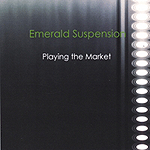
Now a group of artists have made music out of it. Emerald Suspension is a musical unit that -- as it proclaims on its web site -- records music "based on patterns created by the stock market, economic indicators, algorithms, and other data sources." Their album Playing the Market includes songs derived from the Consumer Confidence Index, the efficient market hypothesis, and measures of the national debt. As they describe one piece, "Stock Options":

"Stock Options" is an experimental audio composition based on the Black-Scholes option pricing model and the Put-Call Parity Theorem. The composition is based on stock price, volatility, and interest rate data from 1938 to 1995, the life span of Fischer Black, co-creator of the landmark option pricing formula. The two parts of the composition represent the theoretical price changes of a call option and of a put option on the U.S. stock market over the period.

I just listened to a clip of "Stock Options" over at CDBaby, and it's pretty cool: A creepy, building howl, rather like the sound of storm-force winds whipping through the mooring-wires for electrical towers. Very appropriate!

The only problem is that all the songs are rather atonal, a la John Cage. Possibly this is because they were trying to be faithful to the data, which likely doesn't resolve into tuneful melodies; maybe they're also just big fans of atonal drone music. But to me, there's something tedious about how many wicked-cool conceptual-music projects always wind up producing unhummably shapeless background static. Why not intentionally convert the patterns into diatonic-scale music with repeatable chord patterns? Why not produce something that sounds like traditionally classical or pop music? (As an example, Blur turned the Fibonacci sequence into a hook for one of their songs.) Speaking as a longtime amateur musician with a healthy love of dissonance, there's something kind of easy -- too easy -- about producing experimental electronica that winds up sounding cacophonous and entropic. But creating concept music that's also tuneful? That's hard.

Nonetheless, these guys certainly get an A for effort and originality.


(Thanks to Greg Sewell for this one!)

Posted by Clive Thompson at March 08, 2006 10:23 AM

Trackback Pings

TrackBack URL for this entry: http://www.collisiondetection.net/mt3/mt-tb.cgi/1447

Comments

these guys certainly get an A for effort and originality

Clive, are you joking? Douglas Adams wrote about a program exactly like this in Dirk Gently's Holistic Detective Agency. Amazon says that was published in 1987. The gag was that you dumped in data from the Nikkei, and it just got higher and higher pitched until it was alomst a squeal. I'm suprised it took someone this long to do this in real life.

A quick little search inside says the program was called Anthem. If I remember the same company in the book made another program that MI-6 (or whoever) immediately bought- it detected patterns in ambient noise.

Makes you wonder what these guys are doing on the side.

Posted by: mike d [TypeKey Profile Page] at March 8, 2006 1:30 PM

...and, I suppose that just put to rest any doubts I might have ever had about being a huge geek.

Where's my "Worst Episode Ever" t-shirt?

Posted by: mike d [TypeKey Profile Page] at March 8, 2006 1:32 PM

But to me, there's something tedious about how many wicked-cool conceptual-music projects always wind up producing unhummably shapeless background static.

Amen, Clive! It almost gets to the point where you feel it really doesn't matter at all what the cool, concept-driven, data points are... it's all gonna end up sounding about the same.

The same hold true for most of the arts, but some do a better job of using data as a springboard rather than a restrictive lens. I think you kind of nailed it with the idea of using "repeatable chord patterns." Or you could just say, repeatable patterns. Cut the data into smaller chunks that can be interspersed with something tuneful...

First thing that comes to mind is maybe Art of Noise's "closer to the edge." If it had all been engines and chainsaws it would have sucked, but they make a great addition to the beat when the rest of the song is built around them. There are countless examples of that sort of thing. In an ideal example, the chunks of noise would relate to a data structure, but still have a creative gloss of tunefulness laid over them to hold it together and hold the audience's interest.

Posted by: johntunger [TypeKey Profile Page] at March 8, 2006 1:39 PM

David Suzuki's Sacred Balance series featured a Harvard doctor's research using music to diagnose heart disease.

Surprisingly, unhealthy hearts produce the atonal or excessively repetitive rhythms.

According to the researcher, Dr. Ary Goldberger: "The normal heartbeat although it feels regular and we don't have a sense of what people call palpitations or irregular heartbeats normally, but the normal heartbeat has this very complex, subtle syncopation. It's a very jazzy rhythm that's going on."

The Sacred Balance site include a cool game that play samples of "heartbeat music" and asks you to identify which ones represent healthy or unhealthy hearts.

Posted by: Dusty Bear [TypeKey Profile Page] at March 8, 2006 1:54 PM

Mike -- you busted me. I'd not read that book! I just lost serious geek street cred.

John, yes, precisely, what Art of Noise did is exactly what I'm thinking about!

Dusty Bear -- whoa, I'd never heard about that! I'll probably blog about that separately when I get a chance ... cool!

Posted by: Clive [TypeKey Profile Page] at March 8, 2006 2:58 PM

Charles Dodge's "Earth's Magnetic Field" was one of the first (if not the first) data sonification pieces, and it's pretty tonal (sorry couldn't find a good link to a sample).

I think it gets boring, but it's always held up as a seminal electronic work. Of course, I also think the whole data sonification method is kind of a crock artistically - choose to interpret the data right and your digestive tract will turn into a Blur song.

Posted by: lanier [TypeKey Profile Page] at March 8, 2006 4:56 PM

a brown noise machine, huh?

despite the trivial result, an interesting conceptual homage to fischer black (whose pricing formula was itself based from an assumption of brownian nature of stock prices ...)

also, nothing new under the sun -reminds me of quotezart, a site that used to translate nasdaq trading into soundscape.

Posted by: fatandslat [TypeKey Profile Page] at March 11, 2006 1:11 AM

For decades, people have used equations and noise to generate music and experimented with different ways to modify it so it's tonal and rhythmic. You're right that some tampering is needed to make the data rockable. But at what point does the tampering make it a human composition rather than a representation of nature or some dataset? Can audio be scientifically revealing and ALSO musically rewarding?

Posted by: Matt Hutson [TypeKey Profile Page] at March 13, 2006 3:51 PM

I totally agree with you -- this just isn't good music. But in light of this opinion, how can you say that the "mob art" projects (such as the drawings where everyone changes one pixel at a time) are any good? Can't you see that despite their cool creative premise, the finished product is just dreck, in BOTH SITUATIONS? (Both = mob art and data-based music)

Posted by: Dave Sandoval [TypeKey Profile Page] at March 13, 2006 4:53 PM

Post a comment

Thanks for signing in, . Now you can comment. (sign out)

NOTE: If you posted a comment and you can't see it -- try refreshing your browser.


Remember me?