
« PREVIOUS ENTRY
France to release a balance-the-national-budget video game
NEXT ENTRY »
Using statistics to beat traffic
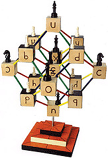
Modern mathematical logic uses a set of sixteen symbols crafted specifically to help you phrase precise logical statements: A dot stands for “and”, a vee for “or”, a horseshoe symbol for “if”. It’s a notoriously abstruse way of thinking, and many philosophy undergrads crash upon its shoals. But a rogue mathematician named Shea Zellweger thinks he has a solution: An entirely new alphabet designed to express logical concepts.
Zellweger has spent decades refining his new logical alphabet, and there’s a big site devoted to it here. But the central benefit of his new notation, he argues, is that his sixteen symbols are related to another: Symbols that mean the opposite of one another are literally the geometric mirror-image of one another — the symbol for “A and B”, a “d”, is a geometric flip of “h”, the symbol for the cognitively flipped idea of “not-A or not-B”.
These physical relationships between his logical letters, Zellweger says, allows a student to sensually perceive the relationships inherent in the language of logic. Here’s a picture of his 16 symbols, which lets you see how they relate:

The thing is, Zellweger thinks his logical language could transform logic the way that the Arabic number set — the one we use today, from 0 to 9 — transformed math after it replaced the use of Roman numerals. Roman mathematicians were hobbled by their crappy notation system. Roman numerals are rather arbitrary: You start off by counting with “I”s, then add a “V” when you get to five, an “L” when you get to fifty, a “C” when you get to a hundred, etc. If you create a multiplication table out of Roman numerals, you can’t spy any inherent order in the math, because the notational system of the numbers is arbitrarily chosen. But if you create a multiplication table out of Arabic numbers, you immediately see the relationships between numbers, because patterns in the number set — from 0 to 9 — emerge visually.
Zellweger’s logical alphabet works the same way. The symbols of mathematical logic, like the Roman-numeral system, are arbitrarily chosen; they don’t relate to one another. If you arrange them in a multiplication-table-like grid, they won’t display any symmetry. But Zellweger’s symbols do, as he proved by creating such a table. Even more wackily, he’s created a 3D sculpture — pictured above — and some gorgeous tesseracts that illustrate the deeper symmetries.
Okay, okay, this is pretty dry stuff. But what’s cool about it is that Zellweger has tackled one of my favorite topics: That your cognitive tools affect how you think. Give kids a better alphabet that represents the internal beauty of formal logic, he argues, and maybe they’ll learn it better. It’s much like Seymor Papert’s use of little toy robots to teach kids about geometry, computer programming, and logic. As he pointed out in an interview:
I also like the fact that one’s interaction with my notation is literally hands-on and physical, rather than just all in your head. Knowledge shouldn’t be disconnected from the body. The body should be used as much as possible as a part of the means through which we acquire and store knowledge. Why can’t logic be like that too?
(Thanks to Jonathan Korman for this one!)
I'm Clive Thompson, the author of Smarter Than You Think: How Technology is Changing Our Minds for the Better (Penguin Press). You can order the book now at Amazon, Barnes and Noble, Powells, Indiebound, or through your local bookstore! I'm also a contributing writer for the New York Times Magazine and a columnist for Wired magazine. Email is here or ping me via the antiquated form of AOL IM (pomeranian99).
ECHO
Erik Weissengruber
Vespaboy
Terri Senft
Tom Igoe
El Rey Del Art
Morgan Noel
Maura Johnston
Cori Eckert
Heather Gold
Andrew Hearst
Chris Allbritton
Bret Dawson
Michele Tepper
Sharyn November
Gail Jaitin
Barnaby Marshall
Frankly, I'd Rather Not
The Shifted Librarian
Ryan Bigge
Nick Denton
Howard Sherman's Nuggets
Serial Deviant
Ellen McDermott
Jeff Liu
Marc Kelsey
Chris Shieh
Iron Monkey
Diversions
Rob Toole
Donut Rock City
Ross Judson
Idle Words
J-Walk Blog
The Antic Muse
Tribblescape
Little Things
Jeff Heer
Abstract Dynamics
Snark Market
Plastic Bag
Sensory Impact
Incoming Signals
MemeFirst
MemoryCard
Majikthise
Ludonauts
Boing Boing
Slashdot
Atrios
Smart Mobs
Plastic
Ludology.org
The Feature
Gizmodo
game girl
Mindjack
Techdirt Wireless News
Corante Gaming blog
Corante Social Software blog
ECHO
SciTech Daily
Arts and Letters Daily
Textually.org
BlogPulse
Robots.net
Alan Reiter's Wireless Data Weblog
Brad DeLong
Viral Marketing Blog
Gameblogs
Slashdot Games

