
« PREVIOUS ENTRY
Plasma Pong: A game of pong played in a plasma field
Ever heard of the “Global Consciousness Project”? It’s a scientific investigation into whether or not ESP exists. Basically, a bunch of scientists at Princeton University have set up dozens of random-number generators around the world. They claim that major world events — such millions of people watching Princess Diana’s funeral — have generated spikes of non-random activity in the number-generators: A “disturbance in the force”, as it were. There is, if you believe them, a “global consciousness”, a human overmind that these machines can detect. Apparently the overmind can even predict the future: Princeton’s random-number generators famously sensed the Sept. 11 attacks four hours before they happened, as well as the Asian tsunami. Of course, the deviations from randomness could just as easily be unrelated to world events. As with much research into the paranormal, it still winds up being a matter of faith. (A sympathetic article on the project is here; a skeptical debunking is here.)
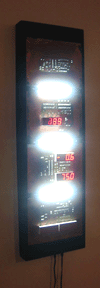
Anyway, this mini-lecture is merely a prequel to the real meat of this blog entry: I just saw the most mind-blowing piece of high-tech art — the “Consciousness Field Resonator”. That’s a snapshot of it above. The Resonator hangs on a wall and generates random numbers in a fashion very similar to the Global Consciousness Project. Then if it detects a sudden spike of nonrandomness, it begins to glow. The artist — Rob Seward — describes it thusly:
Whether or not these forces exist, the user will develop a strong relationship with the device. Any time it “goes off,” the user will try to associate it with a significant event either in his life or the lives of others. Even if his rational mind thinks the basis of this device is complete nonsense, the primitive brain will develop a system of superstitions around the machine. Say the device goes off when the user is having the most amazing sex of his life; or when he receives a phone call that brings news of a relative’s death; or when a terrorist attack occurs in his hometown. Any correlations between events and the device’s behavior will have a visceral impact on the user’s belief system — especially his beliefs about psychic phenomena, physics, spirituality, technology, academic paranormal research, and art. While the device has been constructed with rigorous scientific purpose, interaction with it takes place in a very human and emotional space.
First off, let me say: Seward’s device is flat-out gorgeous! With a dark wood frame and circuit-boards etched out of brass plates, it looks like a piece of mysterious steampunk machinery you’d find in a hidden antechamber of Myst. It’s oddly mesmerizing to watch the randomness flicker across the device’s retro-80s LED signs. (You can watch a video of it in action here.)
But what I really love is how neatly it the Resonator comments on the superstitious, anti-science bent of contemporary American culture. The desire to see meaning in randomness is a hallmark of so much of today’s modern-medieval mindset — such as the Intelligent Design movement. Yet it’s also an impulse incredibly dangerous to science, which seeks to find the true order — not the metaphorically apparent one — in reality. When you stand in front of Seward’s device, it forces you to confront your own craving to find patterns in everyday chaos. It reminds me that naive religious sentiment is sometimes not all that different from some forms of mental illness: Everything happens for a reason. The universe must have wanted it that way. You can hear the same sentiments at a Sunday mass or in a schizophrenia ward, really.
If you ever get a chance to see Seward’s piece on display, check it out: It’s truly thought-provoking.
I'm Clive Thompson, the author of Smarter Than You Think: How Technology is Changing Our Minds for the Better (Penguin Press). You can order the book now at Amazon, Barnes and Noble, Powells, Indiebound, or through your local bookstore! I'm also a contributing writer for the New York Times Magazine and a columnist for Wired magazine. Email is here or ping me via the antiquated form of AOL IM (pomeranian99).
ECHO
Erik Weissengruber
Vespaboy
Terri Senft
Tom Igoe
El Rey Del Art
Morgan Noel
Maura Johnston
Cori Eckert
Heather Gold
Andrew Hearst
Chris Allbritton
Bret Dawson
Michele Tepper
Sharyn November
Gail Jaitin
Barnaby Marshall
Frankly, I'd Rather Not
The Shifted Librarian
Ryan Bigge
Nick Denton
Howard Sherman's Nuggets
Serial Deviant
Ellen McDermott
Jeff Liu
Marc Kelsey
Chris Shieh
Iron Monkey
Diversions
Rob Toole
Donut Rock City
Ross Judson
Idle Words
J-Walk Blog
The Antic Muse
Tribblescape
Little Things
Jeff Heer
Abstract Dynamics
Snark Market
Plastic Bag
Sensory Impact
Incoming Signals
MemeFirst
MemoryCard
Majikthise
Ludonauts
Boing Boing
Slashdot
Atrios
Smart Mobs
Plastic
Ludology.org
The Feature
Gizmodo
game girl
Mindjack
Techdirt Wireless News
Corante Gaming blog
Corante Social Software blog
ECHO
SciTech Daily
Arts and Letters Daily
Textually.org
BlogPulse
Robots.net
Alan Reiter's Wireless Data Weblog
Brad DeLong
Viral Marketing Blog
Gameblogs
Slashdot Games

