
« PREVIOUS ENTRY
Spain to declare rights for great apes
NEXT ENTRY »
The World Cup for robots
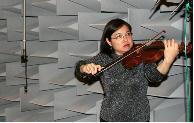
Back in 1994, Mari Kimura introduced the world to a whole new way to play the violin — using subharmonics. Basically, she can produce notes that are up to an octave above and an octave below a violin’s normal range, transforming it from a glass-like synthesizer to a booming cello. (Here’s an audio file of her playing an octave below open G, the violin’s lowest note.)
The thing is, not even Kimura can explain exactly how she does it. So a bunch of scientists at the University of Tromso in Norway recently brought her into an echo-free chamber to record some subharmonic playing; they’re currently studying the data and trying to figure it out. As they explain in this press release:
“Kimura makes a violin string vibrate in a totally new way. In physics we call this a driven and damped non-linear system, which we are particularly preoccupied with in our research. By understanding the way she plays the violin, we are contributing to understanding of similar processes in the nature”, says Hanssen. [snip]
“I have done this for ten years, and the researchers in US and Japan have tried to figure it out for as long. I don’t really know what it is I do, because I have an empirical approach to it. It all happens by the method of trial and error,” says Kimura.
Kimura has written several primers on her technique in the past, and taught several students how to do this — but neither she nor other subharmonicizers has adequately described what the hell they’re doing with that bow. She can describe the fretwork fairly well, as she does here, but the bow magic seems to be a matter of “feel”.
I’ll be intrigued to see what the Norwegian folks find out! Kimura has written several pieces specifically for a subharmonically-played violin — some links to audio files are here online — and they’re quite creepily beautiful to listen to. My favorite is the ending to this snippet of “Subharmonic 2nd”, where Kimura fades out on a quiet blizzard of subharmonic noise; it sounds like a couple of ghost violins muttering at you from a different plane of existence. Check out the way-kewl special notations she’s invented for scripting subharmonic playing.
If she ever plays this stuff live in New York I am so there.
I'm Clive Thompson, the author of Smarter Than You Think: How Technology is Changing Our Minds for the Better (Penguin Press). You can order the book now at Amazon, Barnes and Noble, Powells, Indiebound, or through your local bookstore! I'm also a contributing writer for the New York Times Magazine and a columnist for Wired magazine. Email is here or ping me via the antiquated form of AOL IM (pomeranian99).

ECHO
Erik Weissengruber
Vespaboy
Terri Senft
Tom Igoe
El Rey Del Art
Morgan Noel
Maura Johnston
Cori Eckert
Heather Gold
Andrew Hearst
Chris Allbritton
Bret Dawson
Michele Tepper
Sharyn November
Gail Jaitin
Barnaby Marshall
Frankly, I'd Rather Not
The Shifted Librarian
Ryan Bigge
Nick Denton
Howard Sherman's Nuggets
Serial Deviant
Ellen McDermott
Jeff Liu
Marc Kelsey
Chris Shieh
Iron Monkey
Diversions
Rob Toole
Donut Rock City
Ross Judson
Idle Words
J-Walk Blog
The Antic Muse
Tribblescape
Little Things
Jeff Heer
Abstract Dynamics
Snark Market
Plastic Bag
Sensory Impact
Incoming Signals
MemeFirst
MemoryCard
Majikthise
Ludonauts
Boing Boing
Slashdot
Atrios
Smart Mobs
Plastic
Ludology.org
The Feature
Gizmodo
game girl
Mindjack
Techdirt Wireless News
Corante Gaming blog
Corante Social Software blog
ECHO
SciTech Daily
Arts and Letters Daily
Textually.org
BlogPulse
Robots.net
Alan Reiter's Wireless Data Weblog
Brad DeLong
Viral Marketing Blog
Gameblogs
Slashdot Games


