
« PREVIOUS ENTRY
How to imagine 10 dimensions
NEXT ENTRY »
The seven warning signs of bogus science
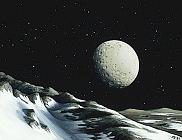
As most astronophiles now know, Pluto’s still a planet. While reading a recent story on the Pluto debate in The New Yorker (sorry, no link because the story’s not online), I happened upon a description of the rules that govern the naming of new planets — and their craters, rings, and other features.
As it turns out, they’re incredibly surreal. Say you’re the lucky astronomer who’s just discovered a new chasm on Venus. What are you permitted to call it? According to the International Astronomical Union, the only permitted names are “Goddesses of hunt” or “moon goddesses.” Maybe you’ve found a bright spot on Ganymede? You can name it after any “Gods and characters of frost, snow, cold, and sleet from myths and folktales of cultures of the Far North.”
The full list of rules is online here. Some of my favorites include:
Small craters of Mars: “Villages of the world with a population of less than 100,000.”
Craters on the moon: “Deceased American astronauts are commemorated by craters in and around the crater Apollo. Appropriate locations will be provided in the future for other space-faring nations should they also suffer fatalities.”
Large ringed features on Callisto: “Places (other than rivers, valleys and ravines) from myths and folktales of cultures of the Far North.”
Small satellites of Uranus: “Heroines from Shakespeare and Pope.”
Small satellites of Neptune: “Gods and goddesses associated with Neptune/Poseidon mythology or generic mythological aquatic beings.”
As I’ve said before, I truly love the culture of astronomers. It’s a nuanced blend of rigorous scientific discipline and baked-out-of-their-minds stoner logic. Half the guys, I swear, if they weren’t mapping the stars with billion-dollar telescopes, they’d be out in California painting unicorns on the sides of vans.
I'm Clive Thompson, the author of Smarter Than You Think: How Technology is Changing Our Minds for the Better (Penguin Press). You can order the book now at Amazon, Barnes and Noble, Powells, Indiebound, or through your local bookstore! I'm also a contributing writer for the New York Times Magazine and a columnist for Wired magazine. Email is here or ping me via the antiquated form of AOL IM (pomeranian99).
ECHO
Erik Weissengruber
Vespaboy
Terri Senft
Tom Igoe
El Rey Del Art
Morgan Noel
Maura Johnston
Cori Eckert
Heather Gold
Andrew Hearst
Chris Allbritton
Bret Dawson
Michele Tepper
Sharyn November
Gail Jaitin
Barnaby Marshall
Frankly, I'd Rather Not
The Shifted Librarian
Ryan Bigge
Nick Denton
Howard Sherman's Nuggets
Serial Deviant
Ellen McDermott
Jeff Liu
Marc Kelsey
Chris Shieh
Iron Monkey
Diversions
Rob Toole
Donut Rock City
Ross Judson
Idle Words
J-Walk Blog
The Antic Muse
Tribblescape
Little Things
Jeff Heer
Abstract Dynamics
Snark Market
Plastic Bag
Sensory Impact
Incoming Signals
MemeFirst
MemoryCard
Majikthise
Ludonauts
Boing Boing
Slashdot
Atrios
Smart Mobs
Plastic
Ludology.org
The Feature
Gizmodo
game girl
Mindjack
Techdirt Wireless News
Corante Gaming blog
Corante Social Software blog
ECHO
SciTech Daily
Arts and Letters Daily
Textually.org
BlogPulse
Robots.net
Alan Reiter's Wireless Data Weblog
Brad DeLong
Viral Marketing Blog
Gameblogs
Slashdot Games

