
« PREVIOUS ENTRY
Does fatherhood change your brain?
NEXT ENTRY »
Can harp music heal a diseased heart?
If you’ve seen the serpentastic film Snakes on Plane, you’re familiar with the movie’s superb use of “Snake-O-Vision” — the many moments when the camera shows a snake’s-eye view of an impending attack. According to the movie, the snakes “see” their prey in green night-vision, with a round pinhole-camera-like center that’s in focus, and a periphery that’s blurry. Like everyone else in the movie theater, I laughed my head off when I saw it.
But then I wondered: How scientifically accurate is Snake-O-Vision?
As it turns out, the question of Snake-O-Vision has long puzzled scientists, particularly in two types of deadly serpents — pit vipers and boid snakes. These snakes can strike prey with accuracy even when they’re blindfolded, which suggests they’re using a “pit organ” on each side of their head that senses infrared radiation. The problem is that these pit organs are one millimeter in size and not very deep — which means they could produce only extremely blurry images. So how do the snakes do it?
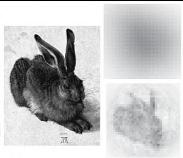
A trio of German scientists now theorize that the snakes use firmware in their brains to error-correct the lousy imagery by harnessing the infrared noise produced by a moving prey. They built a neural-net model in a computer that mimics this, and fed it the actual data produced by a pit organ’s 2000-odd receptors. Presto: It refined the blurry images into startlingly precise results. Check out the example above: There’s the actual bunny, the blurry image from the pit organ (top right), and the result generated by their neural net (bottom right).
Okay, but how do we know this theoretical model matches what’s actually going on inside the snakes’ brains? We don’t — but the theory makes one superb prediction. It’s this: If the pit organ generates even tiny errors, it would ruin the image. To minimize the errors in the scientist’s model, the pit membrane would have to be no more than 15 microns thick — one fifth the thickness of a sheet of paper. And that is precisely the thickness found in a real snake.
As one of the scientists, Leo van Hemmen, told The New Scientist:
“We’ve found a simple way that something seemingly impossible could work in the snake,” he says. “If we could work it out, we’re sure that nature could too.”
A paper on the experiment was published this month in Physical Review Letters, but it is, alas, behind a paywall.
I'm Clive Thompson, the author of Smarter Than You Think: How Technology is Changing Our Minds for the Better (Penguin Press). You can order the book now at Amazon, Barnes and Noble, Powells, Indiebound, or through your local bookstore! I'm also a contributing writer for the New York Times Magazine and a columnist for Wired magazine. Email is here or ping me via the antiquated form of AOL IM (pomeranian99).
ECHO
Erik Weissengruber
Vespaboy
Terri Senft
Tom Igoe
El Rey Del Art
Morgan Noel
Maura Johnston
Cori Eckert
Heather Gold
Andrew Hearst
Chris Allbritton
Bret Dawson
Michele Tepper
Sharyn November
Gail Jaitin
Barnaby Marshall
Frankly, I'd Rather Not
The Shifted Librarian
Ryan Bigge
Nick Denton
Howard Sherman's Nuggets
Serial Deviant
Ellen McDermott
Jeff Liu
Marc Kelsey
Chris Shieh
Iron Monkey
Diversions
Rob Toole
Donut Rock City
Ross Judson
Idle Words
J-Walk Blog
The Antic Muse
Tribblescape
Little Things
Jeff Heer
Abstract Dynamics
Snark Market
Plastic Bag
Sensory Impact
Incoming Signals
MemeFirst
MemoryCard
Majikthise
Ludonauts
Boing Boing
Slashdot
Atrios
Smart Mobs
Plastic
Ludology.org
The Feature
Gizmodo
game girl
Mindjack
Techdirt Wireless News
Corante Gaming blog
Corante Social Software blog
ECHO
SciTech Daily
Arts and Letters Daily
Textually.org
BlogPulse
Robots.net
Alan Reiter's Wireless Data Weblog
Brad DeLong
Viral Marketing Blog
Gameblogs
Slashdot Games

