
« PREVIOUS ENTRY
LOL: Study shows short-forms comprise only 2.4% of teenage IMs
NEXT ENTRY »
Testing, testing. Is this thing on?
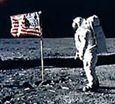
What the heck did Neil Armstrong actually say when he first stepped on the moon? This has always been one of the great debates of lunar exploration. It sounds like he said, “That’s one small step for man, one giant leap for mankind.” But that would not be proper grammar — the correct formulation would be “That’s one small step for a man”. Grammarians have long bemoaned that such a world-famous moment was marred by poor form.
Except that Armstrong has long argued that he did, in fact, say the “a”. He was, after all, an insanely type-A pilot who never said anything without having first carefully rehearsed it in his head, and he certainly knew his grammar. But if you listen to a recording of his speech, you can’t hear any “a”; the acoustic record is so definitive that in the years to come, even Armstrong began to wonder if he’d actually said it. You can’t doubt your ears, right?
Actually, maybe you can. An Australian computer programmer recently got interested in the case and got ahold of a recording of the moon transmission. When he dumped the audio into the sound-editing program Goldwave, he found that there were, indeed, traces of the word:
According to Ford, Armstrong spoke, “One small step for a man … ” with the “a” lasting a total of 35 milliseconds, 10 times too quickly to be heard.”
The “a” was transmitted, though … In the graphic tracing, [Ford] found a signature for the missing “a,” evidence it was spoken and transmitted. Ford then checked First Man and found Hansen’s account of Armstrong’s historic step, as well as the astronaut’s explanation. The account matched what he had found with the GoldWave analysis.
So the mystery is solved, and the grammarians are happy again.
But me, I’m kind of unhappy. I actually preferred the original, agrammatical version — “One small step for man”. Why? Because it scans more beautifully, and thus has much better poetry.
Consider: “For man” perfectly mirrors “for mankind”, which gives the couplet a nice bit of symmetry. If you add an “a” in there, you ruin that flow. More subtly yet, in the original formulation, the number of stressed and unstressed syllables perfectly match. In the first clause, two words (“that’s” and “one”) are nonstressed, while the other four words are stressed. The situation is precisely the same in the second clause: Two words — “one” and “for” — are nonstressed, and four are stressed. To wit:
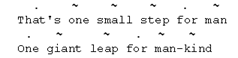
In addition, notice that the second nonstressed word in each clause is the same — “for” — but it occurs one beat earlier in the second clause. This imparts an even more lovely friction to the way the lines scan. They roll off the tongue in almost precisely the same way, and their one point of difference in scansion is nonetheless a point of similarity word-wise. If you put the “a” into the first clause, you add another unstressed syllable, and you irreparably b0rk the otherwise precision-guided elegance of this couplet.
In situations where lofty words are needed, grammar ought to take a back seat to cadence. And indeed, I suspect that’s why Armstrong spoke the “a” so quickly and so quietly. Consciously, he knew that it was grammatically correct; but subconsciously he undoubtedly realized it didn’t sound right, so his brain acted to suppress the “a” and preserve the poetry of the moment. Even 239,000 miles from Earth, you can’t escape the dictates of literature.
I'm Clive Thompson, the author of Smarter Than You Think: How Technology is Changing Our Minds for the Better (Penguin Press). You can order the book now at Amazon, Barnes and Noble, Powells, Indiebound, or through your local bookstore! I'm also a contributing writer for the New York Times Magazine and a columnist for Wired magazine. Email is here or ping me via the antiquated form of AOL IM (pomeranian99).
ECHO
Erik Weissengruber
Vespaboy
Terri Senft
Tom Igoe
El Rey Del Art
Morgan Noel
Maura Johnston
Cori Eckert
Heather Gold
Andrew Hearst
Chris Allbritton
Bret Dawson
Michele Tepper
Sharyn November
Gail Jaitin
Barnaby Marshall
Frankly, I'd Rather Not
The Shifted Librarian
Ryan Bigge
Nick Denton
Howard Sherman's Nuggets
Serial Deviant
Ellen McDermott
Jeff Liu
Marc Kelsey
Chris Shieh
Iron Monkey
Diversions
Rob Toole
Donut Rock City
Ross Judson
Idle Words
J-Walk Blog
The Antic Muse
Tribblescape
Little Things
Jeff Heer
Abstract Dynamics
Snark Market
Plastic Bag
Sensory Impact
Incoming Signals
MemeFirst
MemoryCard
Majikthise
Ludonauts
Boing Boing
Slashdot
Atrios
Smart Mobs
Plastic
Ludology.org
The Feature
Gizmodo
game girl
Mindjack
Techdirt Wireless News
Corante Gaming blog
Corante Social Software blog
ECHO
SciTech Daily
Arts and Letters Daily
Textually.org
BlogPulse
Robots.net
Alan Reiter's Wireless Data Weblog
Brad DeLong
Viral Marketing Blog
Gameblogs
Slashdot Games

