
« PREVIOUS ENTRY
Squid-based design revolutionizes submarine movement
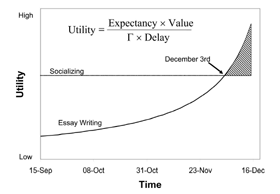
Want to know how badly you’ll procrastinate on a task? Use the formula above. It was created by Piers Steel, a biz-school professor at the University of Calgary, as part of a huge meta-analysis he did of research into procrastination. Steel crunched the 691 different procrastination studies, and came up with some interesting conclusions. Apparently procrastinators “have less confidence in themselves, less expectancy that they can actually complete a task,” as Steel says in this press release. “Perfectionism is not the culprit. In fact, perfectionists actually procrastinate less, but they worry about it more.” About one-fifth of the population are chronic procrastinators, and personality traits that predict your likelihood of procrastinating include how aversive you are to doing tasks, your impulsiveness, your distractibility, and how much you’re driven to achieve.
But it’s his algorithm that really rocks the house. It’s above, in the top center of that graphic. On the top is “expectancy” — how much you expect to succeed at completing the task, or rather, your confidence level in yourself. “Value” is how much you value the task — how important it is to you. Multiply these together and it gives you the overall forward impetus to completing your task.
The denominator captures the element of time. If an activity is enjoyable, it’s something you are likely to delay very little on, so your “Delay” becomes small — and the converse is true. Meanwhile, Γ is your “sensitivity to delay”, which I think means how badly you extend your delays once you start on a procrastination feedback loop.
“Utility” is the result — how likely the task is to be executed quickly. The more the desirability of the task rises in the numerator, or the smaller the time delay in the denominator, the less you’re likely to procrastinate. Or the reverse!
In the chart above, Steel illustrates how the equation nets out in real life. He gives the example of a fictional student — “Thomas Delay” — and shows how the formula predicts the precise moment that he’ll stop going to keggers and start working on his essay. From Steel’s paper:
He is a college student who has been assigned an essay on September 15th, the start of a semester, due on December 15th, when the course ends. To simplify matters, Tom has two choices over the course of his semester: studying or socializing. Tom likes to socialize, but he likes to get good grades even more. However, because the positive component of socializing is perpetually in the present, it maintains a uniformly high utility evaluation. The reward of writing is initially temporally distant, diminishing its utility. Only toward the deadline do the effects of discounting decrease, and writing becomes increasingly likely. In this example, the switch in motivational rank occurs on December 3rd, leaving just 12 days for concentrated effort.
That paper is behind a paywall, unfortunately, but I was so intrigued I got a copy — and pulled the chart and the quote above.
In a nicely meta touch, I actually heard about this paper last Wednesday, and probably could have blogged about it pretty quickly and been the first online with a posting. But I just sort of, y’know, got wrapped up with idle surfing and finishing a level on the latest PSP copy of Medal of Honor and watching the last few episodes of 24 and … time slipped away from me. In the meanwhile, Scientific American published a piece on the study and Boing Boing blogged about it today. [slapping forehead] You snooze, you lose!
By the way, Steel has a way-kewl online app to measure your procrastination level.
I'm Clive Thompson, the author of Smarter Than You Think: How Technology is Changing Our Minds for the Better (Penguin Press). You can order the book now at Amazon, Barnes and Noble, Powells, Indiebound, or through your local bookstore! I'm also a contributing writer for the New York Times Magazine and a columnist for Wired magazine. Email is here or ping me via the antiquated form of AOL IM (pomeranian99).
ECHO
Erik Weissengruber
Vespaboy
Terri Senft
Tom Igoe
El Rey Del Art
Morgan Noel
Maura Johnston
Cori Eckert
Heather Gold
Andrew Hearst
Chris Allbritton
Bret Dawson
Michele Tepper
Sharyn November
Gail Jaitin
Barnaby Marshall
Frankly, I'd Rather Not
The Shifted Librarian
Ryan Bigge
Nick Denton
Howard Sherman's Nuggets
Serial Deviant
Ellen McDermott
Jeff Liu
Marc Kelsey
Chris Shieh
Iron Monkey
Diversions
Rob Toole
Donut Rock City
Ross Judson
Idle Words
J-Walk Blog
The Antic Muse
Tribblescape
Little Things
Jeff Heer
Abstract Dynamics
Snark Market
Plastic Bag
Sensory Impact
Incoming Signals
MemeFirst
MemoryCard
Majikthise
Ludonauts
Boing Boing
Slashdot
Atrios
Smart Mobs
Plastic
Ludology.org
The Feature
Gizmodo
game girl
Mindjack
Techdirt Wireless News
Corante Gaming blog
Corante Social Software blog
ECHO
SciTech Daily
Arts and Letters Daily
Textually.org
BlogPulse
Robots.net
Alan Reiter's Wireless Data Weblog
Brad DeLong
Viral Marketing Blog
Gameblogs
Slashdot Games

