
« PREVIOUS ENTRY
Does the month of your birth affect your risk of mental illness?
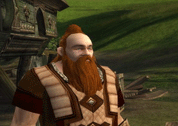
Finally I’m getting back to blogging after a ferocious two weeks of work! I have a big backlog of gaming columns I’ve written for Wired News that I need to post, so here’s the first one: The column that ran today, musing about the issue of race inside online multiplayer worlds.
I’m slightly “eh” about this column, not because I dislike it but because it’s kind of … insufficient. The whole deal about race inside fantasy worlds has been eloquently debated by tons of brilliant people for a couple of decades now, and indeed, there’s been plenty of great online discussion about what the heck is going on with the races in games like World of Warcraft (some of which I link to below) — so this column feels like I’m barely scraping the surface. Then again, “barely scraping the surface” is pretty much the dictionary definition of most journalism, so whaddya gonna do.
Forthwith:
Playing the master race
Why is racism considered bad in the real world — but part of the fun in online games?
By Clive ThompsonWhen I log into the beta of the new Lord of the Rings game, the first thing I do is pick my race. I decide I’m going to be a dwarf: stolid, not so great with magic, but a superb brawler. The idea of being a slightly hotheaded man of the earth appeals to me. And pretty soon I’m engrossed in the task of trying out various big, honking noses.
That’s when it suddenly hits me that this is a really weird, yet central part of online gaming: obsessing about your racial identity and appearance.
I don’t mean “weird” in that it’s unusual. Indeed, every online game begins with you carefully poring over a bouquet of races and picking your favorite. It’s completely normal. No, what’s weird is that this is crazily, dementedly out of step with how I act in my everyday world. In the real world, defining someone by his or her race is considered a classically illiberal act. But in games, racism — making snap judgments about someone based solely on their skin and ethnic identity — is absolutely central to gameplay.
I admit this might seem like a “whoa, dude” stoner epiphany. But the reason it came to mind is because I’m playing a Lord of the Rings game, and J.R.R. Tolkien basically invented the idea of fantasy race-based worlds. The people in Middle Earth were rigidly defined by their race. Hobbits were sensible, if unvisionary; elves were austere and aloof; orcs were unreservedly evil. It ain’t where you’re at — it’s where you’re from. Mostly.
Indeed, Tolkien’s obsessive devotion to race has provoked decades of blistering debates about whether his archetypes were thinly veiled allusions to real-life nationalities — complete with rankings of which ones rocked and which ones sucked. The hobbits seemed like the stolid, sensible Victorian English folk that Tolkien adored; the goblins, with their evil technological genius, could be any scary European enemy army, like the second World War Germans. And the orcs, with their Indo-Asian features? Ahem. “I’m not going there,” said Jeffrey Steefel, the executive producer of the Lord of the Rings online game, with a laugh when I called him to talk race.
Of course, you could argue that game designers adopted racial classifications for entirely different and more benign reasons. It wasn’t, as with Tolkien, a way to meditate on human nature. It was just a great way to ensure diverse gameplay. Having different races in a game allows for a range of characters with different abilities: Dwarves have endurance, elves have magic, orcs have brute force. From a game-design perspective, dividing the world into races is much like dividing chess into six differently powered pieces. So on this level, you could ask, is the weirdly blatant nature of race in games a big deal?
Maybe not. Except that races inside games often seem to reflect, in a creepy way, some of our most regrettable biases about race in real life. For example, when World of Warcraft first came out, players were amused, stunned or both to discover that the evil trolls spoke in … Jamaican accents. Aaron Delwiche, a game academic at Trinity University, asked his student Beth Cox to analyze all the “emotes” in World of Warcraft — the spoken greetings or hand gestures Blizzard pre-programmed into each race. She found that Trolls were “disproportionately more likely to make violent or sexual statements,” Delwiche notes. (Some of their sentences were even scripted in Ebonics: “You going to axe me out?” says the female Troll when you hit the “flirt” command.) In the same way, the “good” alliance characters tended to employ Western, Christian-like symbols, while the evil horde had totems and shamanistic magic. “Clearly, there’s something interesting happening there, and it’s not just coincidence,” Delwiche adds.
There’s evidence, too, that players bring their own racial biases into the game. When Nick Yee, a game academic at Stanford University, polled World of Warcraft players in 2005, he found that while there were nine possible races to choose from, a significant majority — more than half of women and almost half of men — chose to play as the two most “white-looking” and “pretty” races in the game: Humans and elves.
These racial preferences are so powerful that they’ve actually warped and bent the gameplay in curious ways. Yee discovered that the people as humans and elves tended to be newbies, whereas the “evil” characters — like Orcs — were played by younger, more hard-core gamers. The two things were related: It turns out that the whole reason experienced gamers picked “evil” characters is because they were sick of dealing with noobs, and wanted to get away from them. They picked a race that seemed intimidating and scary precisely because they wanted to be intimidating and scary, pretty much the way the death-metal kids at my high school crafted fashion and music to drive the preppies far away.
It throws to an even deeper and stranger question: Does the race that you play as affect your behavior in the game? Yee suspects it can, in possibly subconscious ways. In a new experiment he recently conducted, people who played with “pretty” avatars in an online game were more likely to confide in other players than those who chose intimidatingly mean-looking ones. (He controlled to ensure this wasn’t just a matter of self-selection — i.e., inherently reserved people voluntarily picking uglier avatars.)
The virtual skin you wear, it seems, can affect how you treat other people. “So you start to think, what does it mean to be in that avatar for 20 hours a week?” he asks. (If you want to read a truly spectacular debate on this subject, check out the sprawling thread “The Horde Is Evil” over at Terra Nova.)
Now, this obviously isn’t a simple issue. The identities we pick online are not simple reflections of our real-life personas. On the contrary, most pundits have assumed that online worlds are more like identity sandboxes — places we can screw around with different ways to be. I’ve run into “good” elves that were total jerks, undead villains who behaved in wonderfully altruistic ways and plenty of mincing hottie blood elves who turned out to be balding, middle-aged, married Ohio businessmen. Online games are our refuge from the linear politics of the real world, right?
I’d still like to think so. Though as I sit here tweaking my dwarf’s nose, I admit I’m starting to wonder. Am I playing this character, or is it playing me?
I'm Clive Thompson, the author of Smarter Than You Think: How Technology is Changing Our Minds for the Better (Penguin Press). You can order the book now at Amazon, Barnes and Noble, Powells, Indiebound, or through your local bookstore! I'm also a contributing writer for the New York Times Magazine and a columnist for Wired magazine. Email is here or ping me via the antiquated form of AOL IM (pomeranian99).
ECHO
Erik Weissengruber
Vespaboy
Terri Senft
Tom Igoe
El Rey Del Art
Morgan Noel
Maura Johnston
Cori Eckert
Heather Gold
Andrew Hearst
Chris Allbritton
Bret Dawson
Michele Tepper
Sharyn November
Gail Jaitin
Barnaby Marshall
Frankly, I'd Rather Not
The Shifted Librarian
Ryan Bigge
Nick Denton
Howard Sherman's Nuggets
Serial Deviant
Ellen McDermott
Jeff Liu
Marc Kelsey
Chris Shieh
Iron Monkey
Diversions
Rob Toole
Donut Rock City
Ross Judson
Idle Words
J-Walk Blog
The Antic Muse
Tribblescape
Little Things
Jeff Heer
Abstract Dynamics
Snark Market
Plastic Bag
Sensory Impact
Incoming Signals
MemeFirst
MemoryCard
Majikthise
Ludonauts
Boing Boing
Slashdot
Atrios
Smart Mobs
Plastic
Ludology.org
The Feature
Gizmodo
game girl
Mindjack
Techdirt Wireless News
Corante Gaming blog
Corante Social Software blog
ECHO
SciTech Daily
Arts and Letters Daily
Textually.org
BlogPulse
Robots.net
Alan Reiter's Wireless Data Weblog
Brad DeLong
Viral Marketing Blog
Gameblogs
Slashdot Games

