
« PREVIOUS ENTRY
The roundest objects ever built by hand
NEXT ENTRY »
Is this sea creature real or CGI?
When you’re trying to lose weight, portion control is a big deal, as everyone knows. But how well can we actually tell how big our portions really are? A bunch of elegant experiments by Cornell psychologist Brian Wansink have proved that we suck at judging the quantity of food we’re eating, because we’re regularly tricked by size illusions: If the container serving us is really huge, the amount of food seems smaller and we inadvertantly binge.
Wansink’s experiments are incredibly clever at teasing out how easily we’re fooled. In 2005, he offered moviegoers two-week-old popcorn — “stale enough to squeak when it was eaten” — in medium and super-big buckets; despite the fact that the food tasted like crap, the ones served in super-big buckets ate 33.6% more. (A PDF of his paper is here.) In a 2003 experiment, Wansink served people soup in a bowl that secretly and slowly refilled itself as people ate. They ate 73% more than those served the same soup in regular bowls.
As a profile of Wansink in today’s New York Times points out:
The scariest part is that most of us think we are immune to these hidden persuaders. When the moviegoers were told about the popcorn experiment afterward, most of them scoffed at the idea that their bucket size had any effect on them. “Things like that don’t trick me,” one of the gorgers said.
And as Wansink notes in his soup paper — a PDF is here — the folks who consumed 73% more did not perceive themselves to have eaten any more than normal.
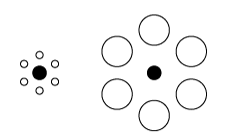
I have this problem with coffee all the time. Coffee shops keep on serving java in increasingly massive cups, so by noon I’ve generally consumed enough caffeine to exterminate a house pet. Indeed, if you really want to eat less, Wansink’s big suggestion is to buy antique plates off Ebay, because plates from the 40s are way, way smaller than today’s plates — so you wind up eating less because your portions seem bigger. He uses that picture above to illustrate the perceptual trick: The black dot’s the same size in each case, but looks smaller in the second picture because the surrounding dots are bigger.
Apparently Wansink wrote up all his findings in a book last year called Mindless Eating, but somehow it slipped under the radar for me; I’m going to go buy it now!
I'm Clive Thompson, the author of Smarter Than You Think: How Technology is Changing Our Minds for the Better (Penguin Press). You can order the book now at Amazon, Barnes and Noble, Powells, Indiebound, or through your local bookstore! I'm also a contributing writer for the New York Times Magazine and a columnist for Wired magazine. Email is here or ping me via the antiquated form of AOL IM (pomeranian99).
ECHO
Erik Weissengruber
Vespaboy
Terri Senft
Tom Igoe
El Rey Del Art
Morgan Noel
Maura Johnston
Cori Eckert
Heather Gold
Andrew Hearst
Chris Allbritton
Bret Dawson
Michele Tepper
Sharyn November
Gail Jaitin
Barnaby Marshall
Frankly, I'd Rather Not
The Shifted Librarian
Ryan Bigge
Nick Denton
Howard Sherman's Nuggets
Serial Deviant
Ellen McDermott
Jeff Liu
Marc Kelsey
Chris Shieh
Iron Monkey
Diversions
Rob Toole
Donut Rock City
Ross Judson
Idle Words
J-Walk Blog
The Antic Muse
Tribblescape
Little Things
Jeff Heer
Abstract Dynamics
Snark Market
Plastic Bag
Sensory Impact
Incoming Signals
MemeFirst
MemoryCard
Majikthise
Ludonauts
Boing Boing
Slashdot
Atrios
Smart Mobs
Plastic
Ludology.org
The Feature
Gizmodo
game girl
Mindjack
Techdirt Wireless News
Corante Gaming blog
Corante Social Software blog
ECHO
SciTech Daily
Arts and Letters Daily
Textually.org
BlogPulse
Robots.net
Alan Reiter's Wireless Data Weblog
Brad DeLong
Viral Marketing Blog
Gameblogs
Slashdot Games

