
« PREVIOUS ENTRY
Why New Yorkers Last Longer: My latest feature in New York magazine
NEXT ENTRY »
Preschoolers can engage in “metacognition”
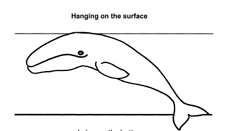
How do whales sleep? It’s always been difficult to tell, because we can’t easily observe their daily habits. But back in the late 90s, a female gray whale was rescued at sea and esconced at Sea World in San Diego, where a couple of scientists recorded its wake/sleep behavior for nine days solid. They wrote a paper with their observations in 1990 (PDF here).
The results? Well, it turns out that a busy day of sieve-feeding benthic crustaceans really knocks you out. The whale slept about 40% of the day, or about 9.5 hours. Also, the whale was diurnal, sleeping, like us, mostly at night.
Cool enough. But given those multiton brains they’re carrying around, the really big question is: Do whales dream? The scientists recorded eye movement and neck-and-body jerks that suggested that indeed, “paradoxical sleep” — REM — might be going on. As they wrote …
… we think that the presence of jerks during rest in the gray whale, taken together with our previous data on three species of dolphins, allows us to suggest that short episodes of PS do exist in Cetaceans in a modified form that is not accompanied by the classical polygraphical or behavioral signs of PS observed in most terrestrial mammals.
So, having duly cited the literature, we are now free to engage in the deliriously unscientific pastime of wondering: What in god’s name are whales dreaming about? The underwater scenery? Prime numbers? The telepathic messages they’re receiving from Alpha Centuri?
My favorite part of the paper is the diagrams showing the posture of the whale during sleep. Apparently she either floated slightly below the surface of the water, or chillaxed on the floor of the tank. Since this wasn’t an in-the-wild observation, of course, it doesn’t tell us whether or not whales would behave the same way in the briny deep, but perhaps future studies will explore this.
(Thanks to Science Blogs for this one!)
I'm Clive Thompson, the author of Smarter Than You Think: How Technology is Changing Our Minds for the Better (Penguin Press). You can order the book now at Amazon, Barnes and Noble, Powells, Indiebound, or through your local bookstore! I'm also a contributing writer for the New York Times Magazine and a columnist for Wired magazine. Email is here or ping me via the antiquated form of AOL IM (pomeranian99).
ECHO
Erik Weissengruber
Vespaboy
Terri Senft
Tom Igoe
El Rey Del Art
Morgan Noel
Maura Johnston
Cori Eckert
Heather Gold
Andrew Hearst
Chris Allbritton
Bret Dawson
Michele Tepper
Sharyn November
Gail Jaitin
Barnaby Marshall
Frankly, I'd Rather Not
The Shifted Librarian
Ryan Bigge
Nick Denton
Howard Sherman's Nuggets
Serial Deviant
Ellen McDermott
Jeff Liu
Marc Kelsey
Chris Shieh
Iron Monkey
Diversions
Rob Toole
Donut Rock City
Ross Judson
Idle Words
J-Walk Blog
The Antic Muse
Tribblescape
Little Things
Jeff Heer
Abstract Dynamics
Snark Market
Plastic Bag
Sensory Impact
Incoming Signals
MemeFirst
MemoryCard
Majikthise
Ludonauts
Boing Boing
Slashdot
Atrios
Smart Mobs
Plastic
Ludology.org
The Feature
Gizmodo
game girl
Mindjack
Techdirt Wireless News
Corante Gaming blog
Corante Social Software blog
ECHO
SciTech Daily
Arts and Letters Daily
Textually.org
BlogPulse
Robots.net
Alan Reiter's Wireless Data Weblog
Brad DeLong
Viral Marketing Blog
Gameblogs
Slashdot Games

