
« PREVIOUS ENTRY
If you can read this, you’re probably already drunk
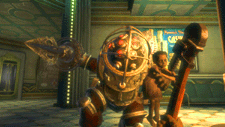
Today, Wired News published my latest video-game column — in which I argue that scary games are now doing a better job than scary movies in carrying on the traditions of horror. The piece is online for free here, and a copy is below!
Gore Is Less: Videogames Make Better Horror Than Hollywood
by Clive ThompsonI’d only been playing BioShock for 15 minutes, and already I was trembling like a little girl.
It’s hard to disentangle what precisely was scaring the crap out of me. Maybe it was hearing the rumbling moans of a nearby Big Daddy, and realizing it was hunting for me. Maybe it was the way those filthy, genetically modified humans would pop out of nowhere, dressed, improbably, in Victorian clothes and creepy Eyes Wide Shut clown masks. Or maybe it was their weirdly garbled dialogue — how they’d shriek, “Get away from me!” while slashing at me with lead pipes.
The fact is, I like to be scared out of my wits. I’m one of those wimps who is easily spooked yet generally enjoys the sensation. So ever since I was a kid, I’ve loved good horror movies — I’d turn out the lights freak myself out with classics like Halloween, Friday the 13th or The Exorcist.
Yet here’s the thing: For several years now, I’ve found that my favorite horror experiences aren’t coming from movies any more. They’re coming from games.
Why? Partly it’s because films have become much less artistically interesting. With a choice few exceptions — like the superb The Ring — I’ve found that modern horror movies have been offering less and less suspense, and more and more gore. Maybe it’s due to the rampaging success of Saw, which gave birth to the current trend toward torture-chic and metric tonnage of blood in scary movies.
In contrast, the best scary-game designers have quietly perfected the interplay of tension and release that makes for a truly cardiac horror experience. They have, in a sense, become even more faithful interpreters of the horror tradition movies than Hollywood directors.
In BioShock, for example, the audio editors are masterful at generating free-floating anxiety. As you wander through the game’s ruined city, whispering voices pan in and out of your skull. Often it’s the semilucid/semicrazy patter of the gibbering “splicer” humans, but either way, it makes you feel as nuts as they are.
Even worse is the sound of the ultra-Freudian evil-girl Little Sisters. Every time I’d stumble into a dark room and hear one of them say “What’s that sound, Mr. Bubbles?” in her chirpy, gargling-on-blood voice, the hair on my neck stood up. It was partly because, well, evil little girls are scary, and partly because I knew I was about to get my ass handed to me.
Indeed, the endless potential for ass-handing is why games may actually be a superior medium to films for scaring the bejesus out of you. The horror flicks of the ’80s always tried to generate a sort of proto-interactivity: all those terrified viewers, screaming “Don’t go in there!” at the screen, wishing they could somehow reach out and personally guide the Final Girl to safety.
In a game, of course, the fourth wall is obliterated, and you actually do have the choice about whether to go into The Bad Room or to run screaming. If you’re a total coward (like me) this ability to control your fate induces considerably more suspense, because I head-game myself into a frenzy. I’ll start down a corridor, hear something freaky up ahead, then freeze in panic. Maybe if I stay quiet the monster will go away? Shit, maybe it’s already headed this way, and I should move! But if I move the monster will hear me … so maybe I should stay quiet … gaaaaah!
Games already seem like dream states. You’re wandering around a strange new world, where you simultaneously are and aren’t yourself. This is already an inherently uncanny experience. That’s why a well-made horror game feels so claustrophobically like being locked inside a really bad — by which I mean a really good — nightmare.
Still, there are some interesting limitations on the form. I find that scary games almost always lose their scariness after about three hours. This is due to the inherent repetitiveness of games: After you’ve fought your 200th “splicer” in BioShock, you’re pretty accustomed to their gurgly ramblings, their patterns of attack, the boo-yah outta-nowhere teleportations. I was still tense, but no longer, you know, wetting myself.
The only way a game can continue to frighten you is if it constantly subjects you to new scary things, keeping you eternally off balance. But few publishers are willing to spend money on enough designer hours to churn out 40 hours of genuinely new content. Instead, they inevitably wind up recycling the same opponents, the same animations, and perhaps worst of all, the same audio cues. (The quickest way to ruin a scary mood is to have the monsters endlessly repeat the same two or three catchphrases over and over again; it begins to feel like telemarketing.) The best horror games — I’d include some of the Silent Hill and Resident Evil titles in this category — have come the closest to keeping things fresh as you play.
Still, I’m not complaining too much. BioShock was plenty freaky enough; I wrote this column with the lights on.
I'm Clive Thompson, the author of Smarter Than You Think: How Technology is Changing Our Minds for the Better (Penguin Press). You can order the book now at Amazon, Barnes and Noble, Powells, Indiebound, or through your local bookstore! I'm also a contributing writer for the New York Times Magazine and a columnist for Wired magazine. Email is here or ping me via the antiquated form of AOL IM (pomeranian99).
ECHO
Erik Weissengruber
Vespaboy
Terri Senft
Tom Igoe
El Rey Del Art
Morgan Noel
Maura Johnston
Cori Eckert
Heather Gold
Andrew Hearst
Chris Allbritton
Bret Dawson
Michele Tepper
Sharyn November
Gail Jaitin
Barnaby Marshall
Frankly, I'd Rather Not
The Shifted Librarian
Ryan Bigge
Nick Denton
Howard Sherman's Nuggets
Serial Deviant
Ellen McDermott
Jeff Liu
Marc Kelsey
Chris Shieh
Iron Monkey
Diversions
Rob Toole
Donut Rock City
Ross Judson
Idle Words
J-Walk Blog
The Antic Muse
Tribblescape
Little Things
Jeff Heer
Abstract Dynamics
Snark Market
Plastic Bag
Sensory Impact
Incoming Signals
MemeFirst
MemoryCard
Majikthise
Ludonauts
Boing Boing
Slashdot
Atrios
Smart Mobs
Plastic
Ludology.org
The Feature
Gizmodo
game girl
Mindjack
Techdirt Wireless News
Corante Gaming blog
Corante Social Software blog
ECHO
SciTech Daily
Arts and Letters Daily
Textually.org
BlogPulse
Robots.net
Alan Reiter's Wireless Data Weblog
Brad DeLong
Viral Marketing Blog
Gameblogs
Slashdot Games

