
« PREVIOUS ENTRY
City hires spy plane to map which houses are wasting energy
NEXT ENTRY »
How to defend Larry Craig with communications theory
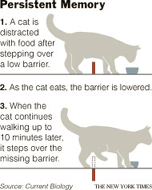
Here’s a cool study: Alberta biologists appear to have demonstrated that spatial memory in cats is cemented not when a cat sees something — but when it navigates around it. Merely perceiving something, for a cat, isn’t enough.
In their experiment — pictured above — they had a cat step halfway over a small barrier, at which point they distracted it with food. They lowered the barrier while it was eating, but when the cat moved on, it still raised its hind legs, believing the barrier to still be there. This is the sort of behavior you’d expect, of course.
But then they repeated the experiment with a twist. This time, the cat was stopped at the point when it had seen the barrier — but before it had stepped its front paws over it. Again, they lowered the barrier while the cat ate the food. But when the cat moved onwards, it didn’t raise its hind legs high enough the clear the now-removed barrier. The cat had seen the barrier, but because it hadn’t been forced to navigate it with its front paws, the barrier hadn’t become part of its spatial memory.
As a story by Henry Fountain in today’s New York Times notes:
“The movement of the forelegs does something unusual,” Mr. McVea said. “It cements the memory of the obstacle.” They had similar results using a barrier that the cat could feel but not see, demonstrating that visual cues were not necessary to create the memory.
Mr. McVea said most likely the brain’s motor cortex, which sends signals to the muscles to initiate movements, was also sending signals to another part of the brain involved in mapping the environment.
Sylvain Fiset, a professor of psychology at the University of Moncton in New Brunswick, said the work suggested that the cognitive processes of cats were adaptable to circumstances and that they “use diverse neural pathways to remember different events.”
I wonder how to what extent our brains work the same way. Some experiments with athletes navigating obstacles, for example, might reveal some neat things about the way we learn sports, gymnastics, and the all-important skill of wandering through your house in the pitch-dark without smashing your shins on furniture.
I'm Clive Thompson, the author of Smarter Than You Think: How Technology is Changing Our Minds for the Better (Penguin Press). You can order the book now at Amazon, Barnes and Noble, Powells, Indiebound, or through your local bookstore! I'm also a contributing writer for the New York Times Magazine and a columnist for Wired magazine. Email is here or ping me via the antiquated form of AOL IM (pomeranian99).
ECHO
Erik Weissengruber
Vespaboy
Terri Senft
Tom Igoe
El Rey Del Art
Morgan Noel
Maura Johnston
Cori Eckert
Heather Gold
Andrew Hearst
Chris Allbritton
Bret Dawson
Michele Tepper
Sharyn November
Gail Jaitin
Barnaby Marshall
Frankly, I'd Rather Not
The Shifted Librarian
Ryan Bigge
Nick Denton
Howard Sherman's Nuggets
Serial Deviant
Ellen McDermott
Jeff Liu
Marc Kelsey
Chris Shieh
Iron Monkey
Diversions
Rob Toole
Donut Rock City
Ross Judson
Idle Words
J-Walk Blog
The Antic Muse
Tribblescape
Little Things
Jeff Heer
Abstract Dynamics
Snark Market
Plastic Bag
Sensory Impact
Incoming Signals
MemeFirst
MemoryCard
Majikthise
Ludonauts
Boing Boing
Slashdot
Atrios
Smart Mobs
Plastic
Ludology.org
The Feature
Gizmodo
game girl
Mindjack
Techdirt Wireless News
Corante Gaming blog
Corante Social Software blog
ECHO
SciTech Daily
Arts and Letters Daily
Textually.org
BlogPulse
Robots.net
Alan Reiter's Wireless Data Weblog
Brad DeLong
Viral Marketing Blog
Gameblogs
Slashdot Games

