
« PREVIOUS ENTRY
Suburbs = old growth forest, as far as owls are concerned
NEXT ENTRY »
Pop!Tech streaming live for the next three days
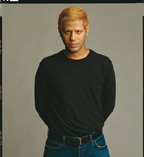
During my Great Blogging Drought of summer 2007, I actually published a dozen or so articles that, bien sur, I didn’t blog about because I wasn’t blogging. So I’m going to slowly post ‘em over the next month or so.
This piece was particularly fun to write: A short profile of Hasan Elahi, an artist guy who accidentally got put on the feds’ watchlists. He realized the best way to keep the FBI off his back was to go totally transparent — so he started photoblogging everything he does, all day long, to establish a constant alibi.
Wired published the piece back in May, so it’s on their site, and a permanently archived copy is below!
The Visible Man: An FBI Target Puts His Whole Life Online
by Clive ThompsonHasan Elahi whips out his Samsung Pocket PC phone and shows me how he’s keeping himself out of Guantanamo. He swivels the camera lens around and snaps a picture of the Manhattan Starbucks where we’re drinking coffee. Then he squints and pecks at the phone’s touchscreen. “OK! It’s uploading now,” says the cheery, 35-year-old artist and Rutgers professor, whose bleached-blond hair complements his fluorescent-green pants. “It’ll go public in a few seconds.” Sure enough, a moment later the shot appears on the front page of his Web site, TrackingTransience.net.
There are already tons of pictures there. Elahi will post about a hundred today — the rooms he sat in, the food he ate, the coffees he ordered. Poke around his site and you’ll find more than 20,000 images stretching back three years. Elahi has documented nearly every waking hour of his life during that time. He posts copies of every debit card transaction, so you can see what he bought, where, and when. A GPS device in his pocket reports his real-time physical location on a map.
Elahi’s site is the perfect alibi. Or an audacious art project. Or both. The Bangladeshi-born American says the US government mistakenly listed him on its terrorist watch list — and once you’re on, it’s hard to get off. To convince the Feds of his innocence, Elahi has made his life an open book. Whenever they want, officials can go to his site and see where he is and what he’s doing. Indeed, his server logs show hits from the Pentagon, the Secretary of Defense, and the Executive Office of the President, among others.
The globe-hopping prof says his overexposed life began in 2002, when he stepped off a flight from the Netherlands and was detained at the Detroit airport. He says FBI agents later told him they’d been tipped off that he was hoarding explosives in a Florida storage unit; subsequent lie detector tests convinced them he wasn’t their man. But with his frequent travel — Elahi logs more than 70,000 air miles a year exhibiting his art work and attending conferences — he figured it was only a matter of time before he got hauled in again. He might even be shipped off to Gitmo before anyone realized their mistake. The FBI agents had given him their phone number, so he decided to call before each trip; that way, they could alert the field offices. He hasn’t been detained since.
So it dawned on him: If being candid about his flights could clear his name, why not be open about everything? “I’ve discovered that the best way to protect your privacy is to give it away,” he says, grinning as he sips his venti Black Eye. Elahi relishes upending the received wisdom about surveillance. The government monitors your movements, but it gets things wrong. You can monitor yourself much more accurately. Plus, no ambitious agent is going to score a big intelligence triumph by snooping into your movements when there’s a Web page broadcasting the Big Mac you ate four minutes ago in Boise, Idaho. “It’s economics,” he says. “I flood the market.”
Elahi says his students get it immediately. They’ve grown up spilling their guts online — posting Flickr photo sets and confessing secrets on MySpace. He figures the day is coming when so many people shove so much personal data online that it will put Big Brother out of business.
For now, though, Big Brother is still on the case. At least according to Elahi’s server logs. “It’s really weird watching the government watch me,” he says. But it sure beats Guantanamo.
I'm Clive Thompson, the author of Smarter Than You Think: How Technology is Changing Our Minds for the Better (Penguin Press). You can order the book now at Amazon, Barnes and Noble, Powells, Indiebound, or through your local bookstore! I'm also a contributing writer for the New York Times Magazine and a columnist for Wired magazine. Email is here or ping me via the antiquated form of AOL IM (pomeranian99).
ECHO
Erik Weissengruber
Vespaboy
Terri Senft
Tom Igoe
El Rey Del Art
Morgan Noel
Maura Johnston
Cori Eckert
Heather Gold
Andrew Hearst
Chris Allbritton
Bret Dawson
Michele Tepper
Sharyn November
Gail Jaitin
Barnaby Marshall
Frankly, I'd Rather Not
The Shifted Librarian
Ryan Bigge
Nick Denton
Howard Sherman's Nuggets
Serial Deviant
Ellen McDermott
Jeff Liu
Marc Kelsey
Chris Shieh
Iron Monkey
Diversions
Rob Toole
Donut Rock City
Ross Judson
Idle Words
J-Walk Blog
The Antic Muse
Tribblescape
Little Things
Jeff Heer
Abstract Dynamics
Snark Market
Plastic Bag
Sensory Impact
Incoming Signals
MemeFirst
MemoryCard
Majikthise
Ludonauts
Boing Boing
Slashdot
Atrios
Smart Mobs
Plastic
Ludology.org
The Feature
Gizmodo
game girl
Mindjack
Techdirt Wireless News
Corante Gaming blog
Corante Social Software blog
ECHO
SciTech Daily
Arts and Letters Daily
Textually.org
BlogPulse
Robots.net
Alan Reiter's Wireless Data Weblog
Brad DeLong
Viral Marketing Blog
Gameblogs
Slashdot Games

