
« PREVIOUS ENTRY
The legal fight over the government’s access to your outboard brain
NEXT ENTRY »
Community urinanalysis: My Times Year in Ideas piece
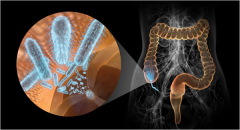
A couple of weeks ago, the New York Times Magazine published its 2007 “Year in Ideas” issue — their annual compendium of the year’s most interesting and offbeat research. I wrote up five of their scientific and technological entries. The entire issue is online here for free, but I’m also archiving my pieces here for posterity’s sake.
This one’s about a new theory for why the appendix exists! That lovely image above, by Bryan Christie Design, accompanied it.
The Appendix Rationale
For years, the appendix got no respect. Doctors regarded it as nothing but a source of trouble: It didn’t seem to do anything, and it sometimes got infected and required an emergency removal. Plus, nobody ever suffered from not having an appendix. So human biologists assumed that the tiny, worm-shaped organ is vestigial — a shrunken remainder of some organ our ancestors required. In a word: Useless.
Now that old theory has been upended. In a December issue of The Journal of Theoretical Biology, a group of scientists announce they have solved the riddle of the appendix. The organ, they claim, is in reality a ”safe house” for healthful bacteria — the stuff that makes our digestive system function. When our gut is ravaged by diseases like diarrhea and dysentery, the appendix quietly goes to work repopulating the gut with beneficial bacteria.
”In essence,” says William Parker, a chemist who co-wrote the paper, ”after our system crashes, the appendix reboots it.” The theory may explain the location of the appendix: Positioned at the beginning of the colon, it often escapes being voided when a sick colon violently empties itself out the bottom.
If the appendix is indeed crucial, why don’t people who have their appendixes removed die? Because in the modern world hygiene and medicine can keep our levels of healthy bacteria adequate. The appendix may have evolved its rebooting function back when our ancestors lived a more vulnerable life — and an entire village might suffer catastrophic diarrhea. In that situation, each gut had to rely on its own resources to recover after a collapse, so the appendix was crucial.
Parker admits the argument is ”deductive.” There’s no way to test it other than performing ”some heinous experiment” — like going to an isolated tribal village, removing half the population’s appendixes and seeing whether that half dies during the next bout of dysentery. Even so, anatomists have been receptive to Parker’s theory. CLIVE THOMPSON
I'm Clive Thompson, the author of Smarter Than You Think: How Technology is Changing Our Minds for the Better (Penguin Press). You can order the book now at Amazon, Barnes and Noble, Powells, Indiebound, or through your local bookstore! I'm also a contributing writer for the New York Times Magazine and a columnist for Wired magazine. Email is here or ping me via the antiquated form of AOL IM (pomeranian99).

ECHO
Erik Weissengruber
Vespaboy
Terri Senft
Tom Igoe
El Rey Del Art
Morgan Noel
Maura Johnston
Cori Eckert
Heather Gold
Andrew Hearst
Chris Allbritton
Bret Dawson
Michele Tepper
Sharyn November
Gail Jaitin
Barnaby Marshall
Frankly, I'd Rather Not
The Shifted Librarian
Ryan Bigge
Nick Denton
Howard Sherman's Nuggets
Serial Deviant
Ellen McDermott
Jeff Liu
Marc Kelsey
Chris Shieh
Iron Monkey
Diversions
Rob Toole
Donut Rock City
Ross Judson
Idle Words
J-Walk Blog
The Antic Muse
Tribblescape
Little Things
Jeff Heer
Abstract Dynamics
Snark Market
Plastic Bag
Sensory Impact
Incoming Signals
MemeFirst
MemoryCard
Majikthise
Ludonauts
Boing Boing
Slashdot
Atrios
Smart Mobs
Plastic
Ludology.org
The Feature
Gizmodo
game girl
Mindjack
Techdirt Wireless News
Corante Gaming blog
Corante Social Software blog
ECHO
SciTech Daily
Arts and Letters Daily
Textually.org
BlogPulse
Robots.net
Alan Reiter's Wireless Data Weblog
Brad DeLong
Viral Marketing Blog
Gameblogs
Slashdot Games

