
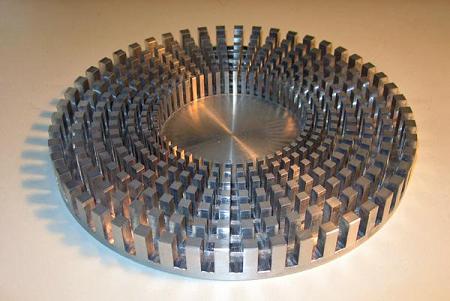
This is incredibly cool: A group of engineers and mathematicians have built a device that renders an object invisible to waves of water.
Last month, I blogged about the ever-more-surreal research into “invisibility cloaks” (including some Chinese guys who invented anti-invisibility technology). As you may recall, the invisibility cloaks all work by hacking the wave nature of light. The cloak consists of a round barrier around an object that takes incoming waves of light — microwave or visible — and reforms them, almost perfectly, on the other side of the barrier. Since the waves coming out have the same shape as the waves going in, presto: The object becomes invisible.
So: If this works with waves of light, could it work with waves of water? Apparently so. This new group of researchers, based in the UK and Europe, created the round metal barrier above, which reformats waves. As the New Scientist reports:
It may look like waves could pass easily along the radial corridors to the cloak’s centre. But they interact with the pillars, producing forces that pull water along the concentric corridors instead.“Basically, the cloak behaves like a whirlpool,” says Sebastian Guenneau at the University of Liverpool, UK, and a member of Enoch’s team. “The further you go into the whirlpool, the faster you rotate.”
The spinning rate increases close to the cloak’s centre where the concentric corridors are narrower, making the forces greater, he explains.
As the water whizzes around the cloak, the waves are flung out again along the radial corridors. “If you imagine water entering the cloak from the north, some leaves the cloak to the east, and some leaves to the west, but most is thrown out at the south,” says Guenneau.
The waves exiting the cloak travel as if they have not been disturbed at all, he says.
The question is whether these devices could be used to protect objects moored at sea, like oil rigs or those crazy artificial islands off the coast of Dubai.
(Thanks to Morgan Noel for this one!)
I'm Clive Thompson, the author of Smarter Than You Think: How Technology is Changing Our Minds for the Better (Penguin Press). You can order the book now at Amazon, Barnes and Noble, Powells, Indiebound, or through your local bookstore! I'm also a contributing writer for the New York Times Magazine and a columnist for Wired magazine. Email is here or ping me via the antiquated form of AOL IM (pomeranian99).

ECHO
Erik Weissengruber
Vespaboy
Terri Senft
Tom Igoe
El Rey Del Art
Morgan Noel
Maura Johnston
Cori Eckert
Heather Gold
Andrew Hearst
Chris Allbritton
Bret Dawson
Michele Tepper
Sharyn November
Gail Jaitin
Barnaby Marshall
Frankly, I'd Rather Not
The Shifted Librarian
Ryan Bigge
Nick Denton
Howard Sherman's Nuggets
Serial Deviant
Ellen McDermott
Jeff Liu
Marc Kelsey
Chris Shieh
Iron Monkey
Diversions
Rob Toole
Donut Rock City
Ross Judson
Idle Words
J-Walk Blog
The Antic Muse
Tribblescape
Little Things
Jeff Heer
Abstract Dynamics
Snark Market
Plastic Bag
Sensory Impact
Incoming Signals
MemeFirst
MemoryCard
Majikthise
Ludonauts
Boing Boing
Slashdot
Atrios
Smart Mobs
Plastic
Ludology.org
The Feature
Gizmodo
game girl
Mindjack
Techdirt Wireless News
Corante Gaming blog
Corante Social Software blog
ECHO
SciTech Daily
Arts and Letters Daily
Textually.org
BlogPulse
Robots.net
Alan Reiter's Wireless Data Weblog
Brad DeLong
Viral Marketing Blog
Gameblogs
Slashdot Games

