
« PREVIOUS ENTRY
Video-game version of crack cocaine
NEXT ENTRY »
Is left-handedness the key to the universe?
Bloggers are freaking out, it seems. Last week, Google changed some of the weighting in its supermysterious PageRank technology — and it has apparently made many popular blogs less likely to be a search result.
Up until now, blogs had it good. They were the answer to which Google had been a question. Google favors results that are well-linked-to — if you have a lot of links to your site, you’re obviously considered valuable in the online world. Thus, blogs (which are networked with an almost hillybillyesque level of inbreeding) used to pop up very high on Google results.
But for some reason (which no one knows, because Google doesn’t explain its technology in depth), Google’s recent changes seem to have altered that. And bloggers are not happy at all.
I’m slightly torn on this one. On the one hand, I think Google’s ranking style is subtly brilliant. By taking its cues from how we link to one another, it defines “what is a a useful site” in a very human way: If other people like it, it must be useful. That’s a wonderful way out of the maze of automatic-text recognition and half-assed semantic A.I. that has plagued so many other search engines, with their attempts to get robot spiders to accurately “read” the content of web sites. Humans are a good judge of content; machines aren’t, not yet anyway. And since I really like blogs, I’ve always loved the fact that Google has neatly reinforced their importance: They’re what people actually link to and consider important — a nice slap in the face of major corporate media. You could go as far as to say that Google essentially created the popularity of the blog.
But on the other hand, should blogs be that popular on Google?
After all, Google’s method leads to a pretty surreal definition of utility. To wit: Is popularity a good index of utility? On the contrary, it’s almost a high-school definition of what’s important: “Why’s that guy popular?” “Uh, because he’s … popular.” This sort of tautology acts itself out on Google all the time. Once something gets a few links made to it, other people get it as a search result on Google, and thus they figure it’s important and link to it, and pretty soon — bingo, the site is entrenched as important.
But in a way, that’s precisely how we humans determine what’s important: We move as a flock from trend to trend, from site to site. If we — en masse — consider something popular, it is thus almost by definition thus important, or culturally revealing, or whatnot. But popularity can stand in the way of growth. Trends work much like ideology: Once one system is in place, it makes it harder to even recognize any new data or information that violates the system. If everyone is convinced one site is important, one fact is important, one trend or idea is important, then it colors what we look for — and what we find when we go looking. For example, people who are convinced the world is more violent literally do not even seem to notice the constant stream of news stories documenting that North American crime is as low as it’s been in decades. Once we’ve got one thing lodged in our conciousness, we have ever more trouble recognizing evidence that will contradict what we already believe. Google, by emulating the way humans think and network, has also emulated our flaws.
This is, now that I think about it, almost precisely the idea behind Thomas Kuhn’s The Structure of Scientific Revolutions.
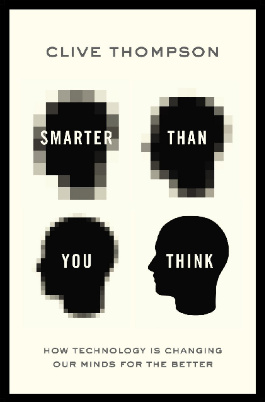
I'm Clive Thompson, the author of Smarter Than You Think: How Technology is Changing Our Minds for the Better (Penguin Press). You can order the book now at Amazon, Barnes and Noble, Powells, Indiebound, or through your local bookstore! I'm also a contributing writer for the New York Times Magazine and a columnist for Wired magazine. Email is here or ping me via the antiquated form of AOL IM (pomeranian99).
ECHO
Erik Weissengruber
Vespaboy
Terri Senft
Tom Igoe
El Rey Del Art
Morgan Noel
Maura Johnston
Cori Eckert
Heather Gold
Andrew Hearst
Chris Allbritton
Bret Dawson
Michele Tepper
Sharyn November
Gail Jaitin
Barnaby Marshall
Frankly, I'd Rather Not
The Shifted Librarian
Ryan Bigge
Nick Denton
Howard Sherman's Nuggets
Serial Deviant
Ellen McDermott
Jeff Liu
Marc Kelsey
Chris Shieh
Iron Monkey
Diversions
Rob Toole
Donut Rock City
Ross Judson
Idle Words
J-Walk Blog
The Antic Muse
Tribblescape
Little Things
Jeff Heer
Abstract Dynamics
Snark Market
Plastic Bag
Sensory Impact
Incoming Signals
MemeFirst
MemoryCard
Majikthise
Ludonauts
Boing Boing
Slashdot
Atrios
Smart Mobs
Plastic
Ludology.org
The Feature
Gizmodo
game girl
Mindjack
Techdirt Wireless News
Corante Gaming blog
Corante Social Software blog
ECHO
SciTech Daily
Arts and Letters Daily
Textually.org
BlogPulse
Robots.net
Alan Reiter's Wireless Data Weblog
Brad DeLong
Viral Marketing Blog
Gameblogs
Slashdot Games

