
« PREVIOUS ENTRY
Fiber optic candy
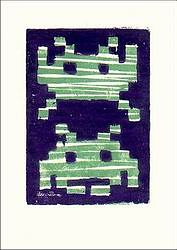
Check it out! My artist friend El Rey has begun making a series of block-prints — using not only wood, but the backing foam from grocery-store pork chops. Among the first set of prints? Renditions of the thud-thud-thuddin’ aliens from Space Invaders!
Go visit his site and buy some of these suckers before they’re all gone. Well, actually, I suppose, given that these are prints, he could always make more. In fact, that’s what’s so cool about these things: El Rey’s using block-making techniques to produce versions of digital icons that themselves were originally generated using ancient block-making techniques.
After all, when those guys were making the early video games, they faced precisely the same challenge as the first artists on the planet: How do you get maximum creative flexibility out of inherently low-rez media? The dudes at Midway were working with 8 bits and a screen that couldn’t be subdivided into more than a few thousand pixels. Primitive man was working with chunks of bone or wood and dyes from pre-chewed berries. Not really all that different in their structural limitations, when you think about it.
That’s why early computer pioneers actually borrowed directly from the techniques of ancient artists. Consider “anti-aliasing”. Back when medieval tapestry weavers and Islamic tile-mosaic artists were doing their work in the 11th to 14th centuries, they innovated a neat technique for making edges appear more curved. If the artists were using black tiles to make a rounded corner, they’d insert a few grey ones in the crevices of right-angled parts — creating the illustion that the corner was smoother than it really was. That technique, anti-aliasing, was later used by Apple fontographers in the early 1980s, when they were trying to create smoother-looking edges on their fonts for the first WYSIWYG Macintosh computers.
Like Mark Twain said, history may not directly repeat itself — but it sure rhymes.
I'm Clive Thompson, the author of Smarter Than You Think: How Technology is Changing Our Minds for the Better (Penguin Press). You can order the book now at Amazon, Barnes and Noble, Powells, Indiebound, or through your local bookstore! I'm also a contributing writer for the New York Times Magazine and a columnist for Wired magazine. Email is here or ping me via the antiquated form of AOL IM (pomeranian99).
ECHO
Erik Weissengruber
Vespaboy
Terri Senft
Tom Igoe
El Rey Del Art
Morgan Noel
Maura Johnston
Cori Eckert
Heather Gold
Andrew Hearst
Chris Allbritton
Bret Dawson
Michele Tepper
Sharyn November
Gail Jaitin
Barnaby Marshall
Frankly, I'd Rather Not
The Shifted Librarian
Ryan Bigge
Nick Denton
Howard Sherman's Nuggets
Serial Deviant
Ellen McDermott
Jeff Liu
Marc Kelsey
Chris Shieh
Iron Monkey
Diversions
Rob Toole
Donut Rock City
Ross Judson
Idle Words
J-Walk Blog
The Antic Muse
Tribblescape
Little Things
Jeff Heer
Abstract Dynamics
Snark Market
Plastic Bag
Sensory Impact
Incoming Signals
MemeFirst
MemoryCard
Majikthise
Ludonauts
Boing Boing
Slashdot
Atrios
Smart Mobs
Plastic
Ludology.org
The Feature
Gizmodo
game girl
Mindjack
Techdirt Wireless News
Corante Gaming blog
Corante Social Software blog
ECHO
SciTech Daily
Arts and Letters Daily
Textually.org
BlogPulse
Robots.net
Alan Reiter's Wireless Data Weblog
Brad DeLong
Viral Marketing Blog
Gameblogs
Slashdot Games


