
« PREVIOUS ENTRY
Scrabble and love
NEXT ENTRY »
Monkey Shakespeare
Yet more indications that file-sharing is more likely to save music than usher in its demise. A radio station in San Francisco has begun using peer-to-peer music-swapping networks as a way to figure out what’s hot amongst listeners. According to ABC:
It’s the job of program director Sean Demery to figure out what people want to hear. One new way is by monitoring what file swappers are searching for and sharing most. And he does it with the help of a market-data software company called Big Champagne.
“It basically gives me pretty much what’s happening in the mass culture,” Demery said. “It tells me what’s popular.”
Eric Garland, CEO of Big Champagne, compares what his company does online to what the Nielsen rating system does for television.
Actually, peer-to-peer sharing is infinitely better than what Nielsen does. Nielsen’s ratings are a mere sampling of a tiny, tiny fraction of the TV-watching audience; networks like Kazaa or Morpheus are filled with millions of millions of folks. (Though they may be biased towards a particular type of music, since file-sharers tend to be younger, I’d bet.) But the point remains: This is an example of people using tech to tap into the unruly spirit of the masses, something that — for all its vaunted attempts to please its audiences — the entertainment industry doesn’t always do very well.
More importantly, it’s an example of how artificial-intelligence techniques are going to become more and more useful. Up until now, they’ve been interesting curiousities — but mostly useful to people like bankers, who have oceans of data they need to sift to find patterns. With peer-to-peer networks, everyday people are now generating oceans of data that we ourselves might want to sift.
(Thanks to Boing Boing for this!)
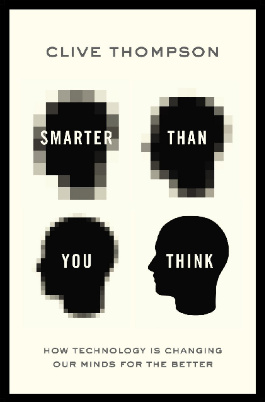
I'm Clive Thompson, the author of Smarter Than You Think: How Technology is Changing Our Minds for the Better (Penguin Press). You can order the book now at Amazon, Barnes and Noble, Powells, Indiebound, or through your local bookstore! I'm also a contributing writer for the New York Times Magazine and a columnist for Wired magazine. Email is here or ping me via the antiquated form of AOL IM (pomeranian99).
ECHO
Erik Weissengruber
Vespaboy
Terri Senft
Tom Igoe
El Rey Del Art
Morgan Noel
Maura Johnston
Cori Eckert
Heather Gold
Andrew Hearst
Chris Allbritton
Bret Dawson
Michele Tepper
Sharyn November
Gail Jaitin
Barnaby Marshall
Frankly, I'd Rather Not
The Shifted Librarian
Ryan Bigge
Nick Denton
Howard Sherman's Nuggets
Serial Deviant
Ellen McDermott
Jeff Liu
Marc Kelsey
Chris Shieh
Iron Monkey
Diversions
Rob Toole
Donut Rock City
Ross Judson
Idle Words
J-Walk Blog
The Antic Muse
Tribblescape
Little Things
Jeff Heer
Abstract Dynamics
Snark Market
Plastic Bag
Sensory Impact
Incoming Signals
MemeFirst
MemoryCard
Majikthise
Ludonauts
Boing Boing
Slashdot
Atrios
Smart Mobs
Plastic
Ludology.org
The Feature
Gizmodo
game girl
Mindjack
Techdirt Wireless News
Corante Gaming blog
Corante Social Software blog
ECHO
SciTech Daily
Arts and Letters Daily
Textually.org
BlogPulse
Robots.net
Alan Reiter's Wireless Data Weblog
Brad DeLong
Viral Marketing Blog
Gameblogs
Slashdot Games

