
« PREVIOUS ENTRY
Hunting naked women: Fact or fiction?
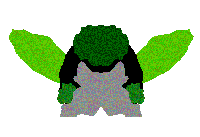
Security freaks tell you that you should always pick a complex, non-intuitive password — a string of gibberish like “xyk95woi”. Most people don’t do this. One day, I asked everyone I knew how they’d developed their email passwords. Sure enough, more than half were just using their own last name — or their birthdate or their cat’s name, or something equally as guessable. This is because of a simple human fact: People have trouble remembering long strings of gibberish. They need some sort of mnemonic.
So a couple of Microsoft researchers figured out a funky new technique for generating — and remembering — complex, weird passwords. They present you with a string of inkblots, like the one above. You figure out what each one looks like to you; then you use the first and last letter of each to generate a password — one that is very gibberish-like indeed. For example, if you saw inkblots that looked like a “fly”, a “helicopter”, a “lung” and a “fish”, you’d have “fyhrlgfh” as your password. When you want to log into your email but you’ve forgotten your password, the software simply shows you the exact same bunch of inkblots — and you remember the words you thought of.
The thing is, this system is almost completely uncrackable. Why? Because of a another quirk of human cognition: No two people ever think an inkblot looks like the same thing. As a Microsoft report on this notes:
Stubblefield and Simon found out that once we’ve identified the inkblot we see it the same way every time. And even though people sometimes see similar things in inkblots, they describe it in different ways. For instance, almost all the users in their study identified the inkblot below as some type of flying person. But the users described their flying person differently, such as ‘evil flying henchman’ or ‘flying gardener.’
Mind you, this is also an insanely complicated system — and as security people will tell you, any security system that’s too complex will be abandoned by its users. They’ll go back to using their cat’s name as a password.
But no, in case you’re wondering — my email isn’t “Smokey”.
(NOTE: There is a totally killer discussion of the psychology of passwords taking place in the discussion thread on this topic. Go read it now!)
(Thanks to Slashdot for this one!)
I'm Clive Thompson, the author of Smarter Than You Think: How Technology is Changing Our Minds for the Better (Penguin Press). You can order the book now at Amazon, Barnes and Noble, Powells, Indiebound, or through your local bookstore! I'm also a contributing writer for the New York Times Magazine and a columnist for Wired magazine. Email is here or ping me via the antiquated form of AOL IM (pomeranian99).
ECHO
Erik Weissengruber
Vespaboy
Terri Senft
Tom Igoe
El Rey Del Art
Morgan Noel
Maura Johnston
Cori Eckert
Heather Gold
Andrew Hearst
Chris Allbritton
Bret Dawson
Michele Tepper
Sharyn November
Gail Jaitin
Barnaby Marshall
Frankly, I'd Rather Not
The Shifted Librarian
Ryan Bigge
Nick Denton
Howard Sherman's Nuggets
Serial Deviant
Ellen McDermott
Jeff Liu
Marc Kelsey
Chris Shieh
Iron Monkey
Diversions
Rob Toole
Donut Rock City
Ross Judson
Idle Words
J-Walk Blog
The Antic Muse
Tribblescape
Little Things
Jeff Heer
Abstract Dynamics
Snark Market
Plastic Bag
Sensory Impact
Incoming Signals
MemeFirst
MemoryCard
Majikthise
Ludonauts
Boing Boing
Slashdot
Atrios
Smart Mobs
Plastic
Ludology.org
The Feature
Gizmodo
game girl
Mindjack
Techdirt Wireless News
Corante Gaming blog
Corante Social Software blog
ECHO
SciTech Daily
Arts and Letters Daily
Textually.org
BlogPulse
Robots.net
Alan Reiter's Wireless Data Weblog
Brad DeLong
Viral Marketing Blog
Gameblogs
Slashdot Games

