
« PREVIOUS ENTRY
When Google erases you, do you exist any more?
NEXT ENTRY »
Robot love
Okay, this has officially ripped the top off my skull.
According to a story in yesterday’s Guardian, revolutionary Chile of the 1970s constructed a prototypical Internet that spanned the country. It was constructed by Stafford Beer, a British management guru famous for his books comparing biological and man-made systems. Sure enough, he designed something that worked almost like a river, draining out of dozens of tributaries:
Until now, obtaining and processing such valuable information - even in richer, more stable countries - had taken governments at least six months. But Project Cybersyn found ways round the technical obstacles. In a forgotten warehouse, 500 telex machines were discovered which had been bought by the previous Chilean government but left unused because nobody knew what to do with them. These were distributed to factories, and linked to two control rooms in Santiago. There a small staff gathered the economic statistics as they arrived, officially at five o’clock every afternoon, and boiled them down using a single precious computer into a briefing that was dropped off daily at La Moneda, the presidential palace.
This wasn’t mere wankery. In 1972, the info-network became essential during a political crisis:
Across Chile, with secret support from the CIA, conservative small businessmen went on strike. Food and fuel supplies threatened to run out. Then the government realised that Cybersyn offered a way of outflanking the strikers. The telexes could be used to obtain intelligence about where scarcities were worst, and where people were still working who could alleviate them. The control rooms in Santiago were staffed day and night. People slept in them - even government ministers. “The rooms came alive in the most extraordinary way,” says Espejo. “We felt that we were in the centre of the universe.” The strike failed to bring down Allende.
Totally wild.
(Thanks to Boing Boing for finding this one!)
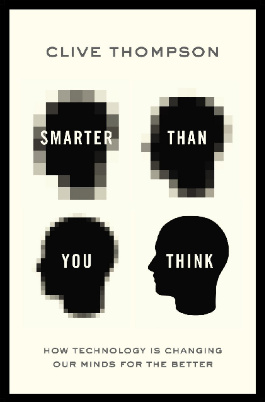
I'm Clive Thompson, the author of Smarter Than You Think: How Technology is Changing Our Minds for the Better (Penguin Press). You can order the book now at Amazon, Barnes and Noble, Powells, Indiebound, or through your local bookstore! I'm also a contributing writer for the New York Times Magazine and a columnist for Wired magazine. Email is here or ping me via the antiquated form of AOL IM (pomeranian99).
ECHO
Erik Weissengruber
Vespaboy
Terri Senft
Tom Igoe
El Rey Del Art
Morgan Noel
Maura Johnston
Cori Eckert
Heather Gold
Andrew Hearst
Chris Allbritton
Bret Dawson
Michele Tepper
Sharyn November
Gail Jaitin
Barnaby Marshall
Frankly, I'd Rather Not
The Shifted Librarian
Ryan Bigge
Nick Denton
Howard Sherman's Nuggets
Serial Deviant
Ellen McDermott
Jeff Liu
Marc Kelsey
Chris Shieh
Iron Monkey
Diversions
Rob Toole
Donut Rock City
Ross Judson
Idle Words
J-Walk Blog
The Antic Muse
Tribblescape
Little Things
Jeff Heer
Abstract Dynamics
Snark Market
Plastic Bag
Sensory Impact
Incoming Signals
MemeFirst
MemoryCard
Majikthise
Ludonauts
Boing Boing
Slashdot
Atrios
Smart Mobs
Plastic
Ludology.org
The Feature
Gizmodo
game girl
Mindjack
Techdirt Wireless News
Corante Gaming blog
Corante Social Software blog
ECHO
SciTech Daily
Arts and Letters Daily
Textually.org
BlogPulse
Robots.net
Alan Reiter's Wireless Data Weblog
Brad DeLong
Viral Marketing Blog
Gameblogs
Slashdot Games

