
« PREVIOUS ENTRY
Binary time
NEXT ENTRY »
The Trojan Defense

Everyone knows parrots can speak simple sentences. But most scientists have assumed parrots aren’t capable of more complex forms of language; that’s the province of higher-order animals like humans and chimps. In the last few years, though, the MIT professor Irene Pepperberg has been conducting some rather amazing experiments with her pet grey parrots. One of them, Alex, has been able to grasp some incredibly nuanced uses of language, as Pepperberg desribes in an interview at The Edge:
We test him not only through direct questions about these concepts (e.g., “What color bigger?” for two differently sized and colored blocks), but also by using questions that involve complex structures—recursive phrases or conjunctive, recursive phrases—such as, “What object is green and three-corner?”; he answers all these questions with about 80% accuracy. We think the reason he doesn’t achieve 100% accuracy is boredom; he seems to get tired of repeatedly telling us about colors and shapes and materials. For example, he sometimes will state every color but the correct one, behavior that suggests that he is carefully avoiding the right answer; statistically, he couldn’t do that by chance.
Check out the rest of the interview; it’s pretty stunning. There’s more info at The Alex Foundation, Pepperberg’s research institute on the “communication and intelligence of parrots.” Ultimately, she sums up the parrots thusly:
What I’ve tried to explain to parrot owners is that what they have in a cage in their living room is a creature with the sentience of a four- to six-year-old child. I try to convince them that you can’t just lock it in a cage for eight hours a day without any kind of interaction.
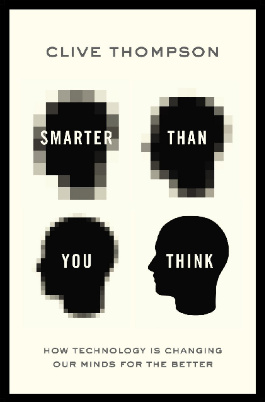
I'm Clive Thompson, the author of Smarter Than You Think: How Technology is Changing Our Minds for the Better (Penguin Press). You can order the book now at Amazon, Barnes and Noble, Powells, Indiebound, or through your local bookstore! I'm also a contributing writer for the New York Times Magazine and a columnist for Wired magazine. Email is here or ping me via the antiquated form of AOL IM (pomeranian99).
ECHO
Erik Weissengruber
Vespaboy
Terri Senft
Tom Igoe
El Rey Del Art
Morgan Noel
Maura Johnston
Cori Eckert
Heather Gold
Andrew Hearst
Chris Allbritton
Bret Dawson
Michele Tepper
Sharyn November
Gail Jaitin
Barnaby Marshall
Frankly, I'd Rather Not
The Shifted Librarian
Ryan Bigge
Nick Denton
Howard Sherman's Nuggets
Serial Deviant
Ellen McDermott
Jeff Liu
Marc Kelsey
Chris Shieh
Iron Monkey
Diversions
Rob Toole
Donut Rock City
Ross Judson
Idle Words
J-Walk Blog
The Antic Muse
Tribblescape
Little Things
Jeff Heer
Abstract Dynamics
Snark Market
Plastic Bag
Sensory Impact
Incoming Signals
MemeFirst
MemoryCard
Majikthise
Ludonauts
Boing Boing
Slashdot
Atrios
Smart Mobs
Plastic
Ludology.org
The Feature
Gizmodo
game girl
Mindjack
Techdirt Wireless News
Corante Gaming blog
Corante Social Software blog
ECHO
SciTech Daily
Arts and Letters Daily
Textually.org
BlogPulse
Robots.net
Alan Reiter's Wireless Data Weblog
Brad DeLong
Viral Marketing Blog
Gameblogs
Slashdot Games

