
« PREVIOUS ENTRY
Have you seen this lost robot cat?
NEXT ENTRY »
Mystery keys
I’m a night owl, and pretty much useless in the mornings. I frequently work until aobut 2 or 3 at night, and then slide out of bed around 10 or 11, and by noon am still barely functioning.
So I was rather delighted to find that, according to a new study, my work-and-sleep patterns may be perfectly designed to maximize how much I learn. A group of scientists at Harvard and the University of Chicago trained people on a difficult skill — such as how to understand murky speech on a tape recorder. Then they tested people later to see how well they’d learned the new skill. One group of people were trained in the morning and tested later in the day. A different set were trained late at night, and then tested after a good night’s sleep.
The results? People who worked late and then slept well performed best. As the Associated Press reports, this may be because sleep is when the brain “absorbs” the knowledge it learned during the day:
The people trained late at night might have performed better because they went to sleep not long after their training, while their counterparts who were trained in the morning were exposed to an entire day of memories before being tested.
Seems like that old aphorism, “sleep on it,” was more prescient than you’d suspect.
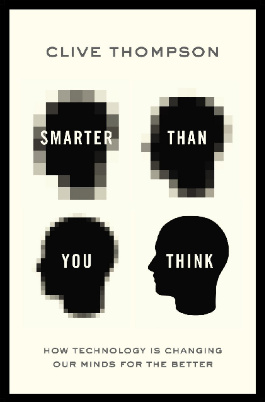
I'm Clive Thompson, the author of Smarter Than You Think: How Technology is Changing Our Minds for the Better (Penguin Press). You can order the book now at Amazon, Barnes and Noble, Powells, Indiebound, or through your local bookstore! I'm also a contributing writer for the New York Times Magazine and a columnist for Wired magazine. Email is here or ping me via the antiquated form of AOL IM (pomeranian99).
ECHO
Erik Weissengruber
Vespaboy
Terri Senft
Tom Igoe
El Rey Del Art
Morgan Noel
Maura Johnston
Cori Eckert
Heather Gold
Andrew Hearst
Chris Allbritton
Bret Dawson
Michele Tepper
Sharyn November
Gail Jaitin
Barnaby Marshall
Frankly, I'd Rather Not
The Shifted Librarian
Ryan Bigge
Nick Denton
Howard Sherman's Nuggets
Serial Deviant
Ellen McDermott
Jeff Liu
Marc Kelsey
Chris Shieh
Iron Monkey
Diversions
Rob Toole
Donut Rock City
Ross Judson
Idle Words
J-Walk Blog
The Antic Muse
Tribblescape
Little Things
Jeff Heer
Abstract Dynamics
Snark Market
Plastic Bag
Sensory Impact
Incoming Signals
MemeFirst
MemoryCard
Majikthise
Ludonauts
Boing Boing
Slashdot
Atrios
Smart Mobs
Plastic
Ludology.org
The Feature
Gizmodo
game girl
Mindjack
Techdirt Wireless News
Corante Gaming blog
Corante Social Software blog
ECHO
SciTech Daily
Arts and Letters Daily
Textually.org
BlogPulse
Robots.net
Alan Reiter's Wireless Data Weblog
Brad DeLong
Viral Marketing Blog
Gameblogs
Slashdot Games

