
« PREVIOUS ENTRY
Sorry for no postings
NEXT ENTRY »
Google bombing, pt. 8
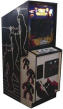
Here’s a blast from the past, and I mean that quite literally: It seems that Taito Corp. has decided to rerelease Space Invaders in the United States — as an arcade cabinet. As Yahoo News reports:
There has been a rebirth of classic video games in America,” said Taito spokesman Kengo Naka. “We thought it would coincide nicely with the 25th anniversary of its debut in the U.S.”
I once described early video games as the hit singles of the digital era — much like the first rock ‘n roll songs that blasted out of jukeboxes in the 50s, back when we still still called it rock ‘n roll. (Actually, my original sentence was an alphanumeric mess: “Games transformed the late 70s and early 80s like 45s transformed the 50s.” Save me from myself.)
Anyway, the point is, yes, this is all very cool — not the least because people like me have yammered on at numbing length about how the design of early games is so uniquely pared down that it boils game-ness down to its platonic essence.
But what I’m really wondering is: Where are these Space Invader cabinets going to go? There aren’t any arcades any more. And by “arcades,” I mean the precise dictionary definition, which is: “A dark, dingy room in a mall that is so ugly and terrifying that parents never dare to enter, thereby giving teenagers one tiny oasis of independence in an otherwise totally surveilled and overly-coordinated life.” So, you know, those horrifyingly Disneyfied “game palaces” they’ve been erecting in most major cities don’t count. They’re not arcades. They’re “game experiences” where creepazoid MBAs from Wall Street go to drink beer and pay, like, four dollars to play House of the Dead for about 23 seconds before they get killed.
That parallel between rock music and games is even more acute when you apply it to the arcade. Arcades scared the living hell out of parents the way that Elvis used to. These days, of course, both Elvis and arcades seem charming and even silly. But you have to remember that back in the 80s, parents went utterly bugshit with alarm when kids first started gathering in those dark, seedy dungeons — where blacklight would pick out every piece of lint on your body, and incredibly creepy guys who had tattoos long before tattoos were cool handed out change from paramilitary dispensers worn like codpieces around their waists.
So the point is: Arcades are gone. They’re dead. They do. Not. Exist. Anymore. Concerned citizens ran a 25-year campaign of groundless hype about how arcades caused juvenile delinquency and teenage torpor and loose sex. None of it was true; the last time I went searching for data on this topic, I was able to find only one single study (of an arcade in Victoria, British Columbia), and it concluded that the arcade had “no perceptible impact” on the moral fiber of the community. Yet nonetheless, the campaign against arcades was one of the most unqualified successes of 50 years of parental freak-outs. Parents have, at different times, flipped out baselessly over grunge, German “death metal,” Madonna, platform shoes, rap, and Britney Spears’ schoolgirl outfits … yet all those cultural icons still thrive. Not so with arcades. Arcades were squashed, city by city, shut down by moral freaks and/or transformed into imagineered playgrounds, until really none are left.
So sure, go ahead — bring back the Space Invaders cabinets! But where are you gonna put them?
(Thanks to El Rey for finding this one!)
I'm Clive Thompson, the author of Smarter Than You Think: How Technology is Changing Our Minds for the Better (Penguin Press). You can order the book now at Amazon, Barnes and Noble, Powells, Indiebound, or through your local bookstore! I'm also a contributing writer for the New York Times Magazine and a columnist for Wired magazine. Email is here or ping me via the antiquated form of AOL IM (pomeranian99).
ECHO
Erik Weissengruber
Vespaboy
Terri Senft
Tom Igoe
El Rey Del Art
Morgan Noel
Maura Johnston
Cori Eckert
Heather Gold
Andrew Hearst
Chris Allbritton
Bret Dawson
Michele Tepper
Sharyn November
Gail Jaitin
Barnaby Marshall
Frankly, I'd Rather Not
The Shifted Librarian
Ryan Bigge
Nick Denton
Howard Sherman's Nuggets
Serial Deviant
Ellen McDermott
Jeff Liu
Marc Kelsey
Chris Shieh
Iron Monkey
Diversions
Rob Toole
Donut Rock City
Ross Judson
Idle Words
J-Walk Blog
The Antic Muse
Tribblescape
Little Things
Jeff Heer
Abstract Dynamics
Snark Market
Plastic Bag
Sensory Impact
Incoming Signals
MemeFirst
MemoryCard
Majikthise
Ludonauts
Boing Boing
Slashdot
Atrios
Smart Mobs
Plastic
Ludology.org
The Feature
Gizmodo
game girl
Mindjack
Techdirt Wireless News
Corante Gaming blog
Corante Social Software blog
ECHO
SciTech Daily
Arts and Letters Daily
Textually.org
BlogPulse
Robots.net
Alan Reiter's Wireless Data Weblog
Brad DeLong
Viral Marketing Blog
Gameblogs
Slashdot Games

