
« PREVIOUS ENTRY
I’m sorry Dave, I can’t let you do that. No, I mean, like, seriously dude, you really shouldn’t do that
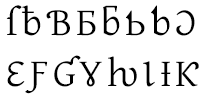
One of the interesting cultural problems of the Internet is that most fonts aren’t created to display more than one or two languages. If you visit foreign-language sites, you’ll notice that you’re always having to download “language packs” so that your browser can display the words correctly, with all the characters unique to the country’s language.
Victor Gaultney, a font designer, decided to tackle this problem by creating the Gentium typeface. His mission, as he describes it, is:
Gentium is a Unicode typeface that contains Roman, Greek and Cyrillic characters, including many characters seldom seen in even the most ambitious typefaces. Far from being a luxury, these characters are needed to write many of the over 6,000 languages thought to exist in the world.
He’s not quite there yet; Gentium only covers the Roman, Greek and Cyrillic scripts, which are historically pretty closely linked and thus typologically similar. It’ll be a while before he starts including the script for minor dialects spoken primarily in Ulan Bator. But nonetheless, the project is fascinating because it highlights an interesting point: That fonts are political, or at very least, have political implications. There’s a great interview with Gaultney on his site, in which he talks about how a font can affect global discourse:
Gentium has managed to break down some of the barriers between people. There used to be a wide gulf between the greater publishing, academic and multilingual communities. Publishers would hesitate to do work in unusual languages because the available fonts were so poor. Academics had to do their own thing because the industry did not support their needs. Multilingual publishing has often been a constant struggle with incompatible solutions of varying quality. Now everyone can use the same font — and get excellent quality, readable, attractive text.
What’s particularly cool is that he’s made Gentium free for download; you can get a copy of it here.
(Thanks to Snarkmarket for this one!)
I'm Clive Thompson, the author of Smarter Than You Think: How Technology is Changing Our Minds for the Better (Penguin Press). You can order the book now at Amazon, Barnes and Noble, Powells, Indiebound, or through your local bookstore! I'm also a contributing writer for the New York Times Magazine and a columnist for Wired magazine. Email is here or ping me via the antiquated form of AOL IM (pomeranian99).
ECHO
Erik Weissengruber
Vespaboy
Terri Senft
Tom Igoe
El Rey Del Art
Morgan Noel
Maura Johnston
Cori Eckert
Heather Gold
Andrew Hearst
Chris Allbritton
Bret Dawson
Michele Tepper
Sharyn November
Gail Jaitin
Barnaby Marshall
Frankly, I'd Rather Not
The Shifted Librarian
Ryan Bigge
Nick Denton
Howard Sherman's Nuggets
Serial Deviant
Ellen McDermott
Jeff Liu
Marc Kelsey
Chris Shieh
Iron Monkey
Diversions
Rob Toole
Donut Rock City
Ross Judson
Idle Words
J-Walk Blog
The Antic Muse
Tribblescape
Little Things
Jeff Heer
Abstract Dynamics
Snark Market
Plastic Bag
Sensory Impact
Incoming Signals
MemeFirst
MemoryCard
Majikthise
Ludonauts
Boing Boing
Slashdot
Atrios
Smart Mobs
Plastic
Ludology.org
The Feature
Gizmodo
game girl
Mindjack
Techdirt Wireless News
Corante Gaming blog
Corante Social Software blog
ECHO
SciTech Daily
Arts and Letters Daily
Textually.org
BlogPulse
Robots.net
Alan Reiter's Wireless Data Weblog
Brad DeLong
Viral Marketing Blog
Gameblogs
Slashdot Games

