
« PREVIOUS ENTRY
Your personal map
NEXT ENTRY »
Help write the world’s longest poem
Years ago, I got the idea for an Internet Mood Ring. I thought it’d be fun to write a little application that would sit in the corner of your screen, showing you two small buttons. They would mimic the color range of a mood ring — they’d glow black for a “bad” mood, then gradually lighten through reds and oranges and greens until they glowed blue for a “good” mood. The first button represented your mood; you’d click on it to bring up a slider, and slide it to represent the right color. The other button would represent the average of all the other moods of all the other users of the application. That way you could watch as the world’s mood shifted and changed during the day — and you could also, in a quick glance, compare your mood to that of the world at large.
I actually wondered if this wouldn’t produce some really weird Heisenbergian feedback effects; if you looked at the buttons and realized you were feeling better than the rest of the world, would that make you feel better still, causing you to dial your personal mood higher, thus causing the overall mood of the world to improve? And if everyone in a better-than-average mood did the same thing, wouldn’t that have a distortion effect on the world’s mood — bringing it higher? Or would the same thing happen in reverse: Maybe the people who realized they were lower than average would get even more depressed, dial themselves lower, and thus drag the average back down.
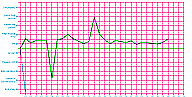
Anyway, I was too lazy to do anything about this. But I was pleased to find out the fine folks at Benrik had roughly the same idea — and they actually pulled it off! Go to the World Mood Chart, input your mood, and it’ll generate chart showing you how the mood of the world has gone up and down that month.
The chart above is for February. Clearly, something happened on Feb. 7 that just totally harshed the world’s mellow, because the mood dropped to somewhere between “Mad As Hell” and “Deeply Depressed”. Any idea as to what went on that day that could have shifted the mood of the entire planet?
(Thanks to Plastic Bag for this one!)
I'm Clive Thompson, the author of Smarter Than You Think: How Technology is Changing Our Minds for the Better (Penguin Press). You can order the book now at Amazon, Barnes and Noble, Powells, Indiebound, or through your local bookstore! I'm also a contributing writer for the New York Times Magazine and a columnist for Wired magazine. Email is here or ping me via the antiquated form of AOL IM (pomeranian99).
ECHO
Erik Weissengruber
Vespaboy
Terri Senft
Tom Igoe
El Rey Del Art
Morgan Noel
Maura Johnston
Cori Eckert
Heather Gold
Andrew Hearst
Chris Allbritton
Bret Dawson
Michele Tepper
Sharyn November
Gail Jaitin
Barnaby Marshall
Frankly, I'd Rather Not
The Shifted Librarian
Ryan Bigge
Nick Denton
Howard Sherman's Nuggets
Serial Deviant
Ellen McDermott
Jeff Liu
Marc Kelsey
Chris Shieh
Iron Monkey
Diversions
Rob Toole
Donut Rock City
Ross Judson
Idle Words
J-Walk Blog
The Antic Muse
Tribblescape
Little Things
Jeff Heer
Abstract Dynamics
Snark Market
Plastic Bag
Sensory Impact
Incoming Signals
MemeFirst
MemoryCard
Majikthise
Ludonauts
Boing Boing
Slashdot
Atrios
Smart Mobs
Plastic
Ludology.org
The Feature
Gizmodo
game girl
Mindjack
Techdirt Wireless News
Corante Gaming blog
Corante Social Software blog
ECHO
SciTech Daily
Arts and Letters Daily
Textually.org
BlogPulse
Robots.net
Alan Reiter's Wireless Data Weblog
Brad DeLong
Viral Marketing Blog
Gameblogs
Slashdot Games

