
« PREVIOUS ENTRY
Comcast’s army of zombies
NEXT ENTRY »
Manhattan’s “centerline sunset”
Plenty of programmers create quickie online knock-offs of Breakout, the classic arcade game. But very few ever actually alter the gameplay in any way. The basic design of Breakout is so well-crafted that it’s hard to improve. Indeed, this is one of the hallmarks of a truly superb game: The rules are so simple, well-balanced and intuitive that when you change any of them, the experience falls apart.
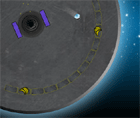
But now someone has actually managed to produce a genuinely new style of Breakout — by making the playboard circular. Over at Playaholics, they’ve released Plastic Balls. In this game, there’s a “drain” in the middle of the circle, protected by a paddle that revolves around it. The “drain” is magnetic — or has some sort of gravitational pull — so the ball falls toward it, and you have to continually bop it away and towards the circumference of the circle, to eliminate all the blocks.
This is utterly ingenious, for a couple of design reasons:
i) It allows for some weird new techniques and challenges in ball trajectory. In normal Breakout, you often had to use the walls intelligently, to try and reach difficult spots with your ball. But here the walls are curved, so you have to learn and master an entirely new style of bouncing. Plus, there are no “side” walls to collide off of. The ball can go 360 degrees around in a circle.
ii) The concept of making the center drain “magnetic” is lovely — because it allows for powerups that mess with the idea of magnetism. One powerup reverses the polarity of attraction: For 30 seconds or so, your paddle repels the ball like two south poles on two magnets pushing away from one another. This allows for ever weirder ball-bouncing strategies.
iii) Since your paddle rotates in a tight circle around the drain, you can spin it around and use the back of the paddle for some even cooler bouncing tricks.
iv) Most importantly, this is the first Breakout clone to use the mouse in a style that is germane to the design of the game. I’ve always disliked online versions of Breakout done in the old-school style — i.e. the paddle moves back and forth across the bottom of the screen — because it’s actually quite hard to control using a mouse. A mouse isn’t really designed to have you track something on an X or a Y axis alone. It’s designed to be pointer that fluently moves through both axes at once. With Plastic Balls, that’s precisely what you’re doing — moving the mouse around in two dimensions to control the paddle.
Anyway, this entry probably makes no sense at all unless you’ve played the game. Go try out, then re-read this and see if I’m making any sense!
I'm Clive Thompson, the author of Smarter Than You Think: How Technology is Changing Our Minds for the Better (Penguin Press). You can order the book now at Amazon, Barnes and Noble, Powells, Indiebound, or through your local bookstore! I'm also a contributing writer for the New York Times Magazine and a columnist for Wired magazine. Email is here or ping me via the antiquated form of AOL IM (pomeranian99).

ECHO
Erik Weissengruber
Vespaboy
Terri Senft
Tom Igoe
El Rey Del Art
Morgan Noel
Maura Johnston
Cori Eckert
Heather Gold
Andrew Hearst
Chris Allbritton
Bret Dawson
Michele Tepper
Sharyn November
Gail Jaitin
Barnaby Marshall
Frankly, I'd Rather Not
The Shifted Librarian
Ryan Bigge
Nick Denton
Howard Sherman's Nuggets
Serial Deviant
Ellen McDermott
Jeff Liu
Marc Kelsey
Chris Shieh
Iron Monkey
Diversions
Rob Toole
Donut Rock City
Ross Judson
Idle Words
J-Walk Blog
The Antic Muse
Tribblescape
Little Things
Jeff Heer
Abstract Dynamics
Snark Market
Plastic Bag
Sensory Impact
Incoming Signals
MemeFirst
MemoryCard
Majikthise
Ludonauts
Boing Boing
Slashdot
Atrios
Smart Mobs
Plastic
Ludology.org
The Feature
Gizmodo
game girl
Mindjack
Techdirt Wireless News
Corante Gaming blog
Corante Social Software blog
ECHO
SciTech Daily
Arts and Letters Daily
Textually.org
BlogPulse
Robots.net
Alan Reiter's Wireless Data Weblog
Brad DeLong
Viral Marketing Blog
Gameblogs
Slashdot Games

