
« PREVIOUS ENTRY
Clock coolness
NEXT ENTRY »
Wanted: Young, hot workers with symmetrical bodies
Apparently, the scientists at AWAKE — a British “sleep management consultancy” — have developed an equation that predicts when you’ll be most tired, depending on your average daily sleep and waking patterns. The equation is …
CDA + CT + KF = TMT
… where CDA is the hour of our daily dip is alertness, CT is our “chronotype” (our personal daily rhythm), and KF is a set of influencing factors such as prior sleep quality and alcohol intake. The result, TMT, is the time of day that we’re most likely to feel tired.
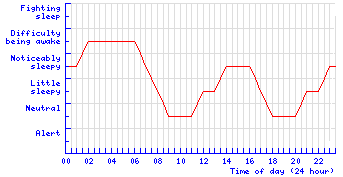
The web site KnackerFactor has created an online version of this algorithm, which asks you a bunch of questions and then spits out a chart showing how sleepy — or alert — you’ll be throughout the day. I punched in my stats for last night, including the following data points: I’m generally a night owl; I generally struggle out of bed; however, last night I went to bed around 11:30; I had one glass of wine with dinner; and I woke up at 7:30 am.
The result? Check the chart above. Apparently, the first couple hours of my workday were supposed to be among my most alert and productive. Reader, allow me to express just how insanely wrong was that prediction. Sure, I managed to drag myself out of bed, but I moved around the office like a snail. I am really not a morning person. Interestingly, the chart also predicts that I’m supposed to be heading into a “noticeably sleepy” zone right now — around 1 pm — but since I’m on my second bucket of coffee, I’m actually feeling quite alert and efficient!
Of course, being a total idiot, I’m spending these high-productivity hours blogging instead of doing actual, paid work.
(Thanks to The J-Walk Blog for this one!)
I'm Clive Thompson, the author of Smarter Than You Think: How Technology is Changing Our Minds for the Better (Penguin Press). You can order the book now at Amazon, Barnes and Noble, Powells, Indiebound, or through your local bookstore! I'm also a contributing writer for the New York Times Magazine and a columnist for Wired magazine. Email is here or ping me via the antiquated form of AOL IM (pomeranian99).
ECHO
Erik Weissengruber
Vespaboy
Terri Senft
Tom Igoe
El Rey Del Art
Morgan Noel
Maura Johnston
Cori Eckert
Heather Gold
Andrew Hearst
Chris Allbritton
Bret Dawson
Michele Tepper
Sharyn November
Gail Jaitin
Barnaby Marshall
Frankly, I'd Rather Not
The Shifted Librarian
Ryan Bigge
Nick Denton
Howard Sherman's Nuggets
Serial Deviant
Ellen McDermott
Jeff Liu
Marc Kelsey
Chris Shieh
Iron Monkey
Diversions
Rob Toole
Donut Rock City
Ross Judson
Idle Words
J-Walk Blog
The Antic Muse
Tribblescape
Little Things
Jeff Heer
Abstract Dynamics
Snark Market
Plastic Bag
Sensory Impact
Incoming Signals
MemeFirst
MemoryCard
Majikthise
Ludonauts
Boing Boing
Slashdot
Atrios
Smart Mobs
Plastic
Ludology.org
The Feature
Gizmodo
game girl
Mindjack
Techdirt Wireless News
Corante Gaming blog
Corante Social Software blog
ECHO
SciTech Daily
Arts and Letters Daily
Textually.org
BlogPulse
Robots.net
Alan Reiter's Wireless Data Weblog
Brad DeLong
Viral Marketing Blog
Gameblogs
Slashdot Games

