
« PREVIOUS ENTRY
Back-to-Iraq blog heads back to Iraq
NEXT ENTRY »
Sharks with frickin’ laser beams
This is one of the more face-melting science stories I’ve encountered in a while. Over at Slate, Jim Holt wrote a terrific piece about Andrei Linde, a physicist with an unusual theory about the origins of the universe. He argues that a universe isn’t terribly hard to create: Indeed, theoretically, one could create one in a lab, using only one hundred-thousandth of a gram of matter. Assuming all goes well, it would expand, but with such curved space that it would — for all intents and purposes — implode, vanishing from “our” reality while expanding in its own dimensionality.
Here’s the fun part: According to Linde’s theory, the creator of a universe would be able to determine the basic constituent elements of its reality, such as its level of gravity, the speed of light, etc. And in doing so, the creator could essentially communicate with her or his creation:
The creator, by manipulating the cosmic seed in the right way, has the power to ordain certain physical parameters of the universe he ushers into being. So says the theory. He can determine, for example, what the numerical ratio of the electron’s mass to the proton’s will be. Such ratios, called constants of nature, look like arbitrary numbers to us: There is no obvious reason they should take one value rather than another. (Why, for instance, is the strength of gravity in our universe determined by a number with the digits 6673?) But the creator, by fixing certain values for these dozens of constants, could write a subtle message into the very structure of the universe. And, as Linde hastened to point out, such a message would be legible only to physicists.
This is a really lovely thought. Maybe Earth phyicists will eventually piece together some grand pattern in the design of our universe, and discover a message encoded … by a sessional grad student at Stanford.
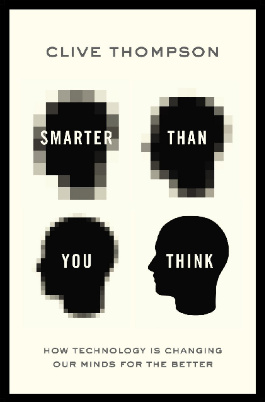
I'm Clive Thompson, the author of Smarter Than You Think: How Technology is Changing Our Minds for the Better (Penguin Press). You can order the book now at Amazon, Barnes and Noble, Powells, Indiebound, or through your local bookstore! I'm also a contributing writer for the New York Times Magazine and a columnist for Wired magazine. Email is here or ping me via the antiquated form of AOL IM (pomeranian99).
ECHO
Erik Weissengruber
Vespaboy
Terri Senft
Tom Igoe
El Rey Del Art
Morgan Noel
Maura Johnston
Cori Eckert
Heather Gold
Andrew Hearst
Chris Allbritton
Bret Dawson
Michele Tepper
Sharyn November
Gail Jaitin
Barnaby Marshall
Frankly, I'd Rather Not
The Shifted Librarian
Ryan Bigge
Nick Denton
Howard Sherman's Nuggets
Serial Deviant
Ellen McDermott
Jeff Liu
Marc Kelsey
Chris Shieh
Iron Monkey
Diversions
Rob Toole
Donut Rock City
Ross Judson
Idle Words
J-Walk Blog
The Antic Muse
Tribblescape
Little Things
Jeff Heer
Abstract Dynamics
Snark Market
Plastic Bag
Sensory Impact
Incoming Signals
MemeFirst
MemoryCard
Majikthise
Ludonauts
Boing Boing
Slashdot
Atrios
Smart Mobs
Plastic
Ludology.org
The Feature
Gizmodo
game girl
Mindjack
Techdirt Wireless News
Corante Gaming blog
Corante Social Software blog
ECHO
SciTech Daily
Arts and Letters Daily
Textually.org
BlogPulse
Robots.net
Alan Reiter's Wireless Data Weblog
Brad DeLong
Viral Marketing Blog
Gameblogs
Slashdot Games

