
« PREVIOUS ENTRY
My Slate column on computer illiteracy
NEXT ENTRY »
The corpse plant is blooming!
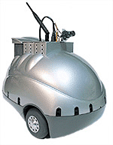
Two years ago, when I headed off to a science-journalism fellowship in Boston, I realized that I’d spend nine months in a long-distance relationship with my New York girlfriend. Being long-distance sucks, so I was trying to figure out ways to simulate being together as much as possible. We already IMed a lot, so we had a lot of virtual “presence.” But I wanted more than that. I wanted telepresence. I wanted a robot avatar that I could command from afar, and use as my proxy in her physical space.
You might well ask why in hell this chick goes out with me, but that would clearly be a much longer post.
Anyway, the point is, I originally hoped to get my hands on a first-generation iRobot. You probably know iRobot as the company that makes the impossibly cute Roomba. But iRobot’s original product was a full-on telepresence ‘bot. You could leave it in whatever location you wanted, and when you needed to virtually visit, you’d use a web interface to remotely “robot in” and control the avatar — seeing what it saw through its webcam eyes, and speaking to people in the room using its speakers. It was just beyond righteous. Unfortunately, it was also somewhere north of $3,000 and the company had sadly stopped making them. So I gave up on my dreams of creepy stalker robotic telepresence.
Until I logged on today and got wind of the Pekee robot by Wany Robotics. It’s even more expensive — $10,000 — but seems nicely customizable for remote control. As the manufacturer’s web site points out:
The Pekee robot is designed around a completely open architecture that provides total flexibility for your robotic application testing and development. Its built-in infrared, temperature, and light sensors, odometers, shock detector, and gyrometers ensure that you can monitor critical elements in the robot’s environment at all times. The Pekee platform lets you pursue your own projects at all levels, from trajectory planning to real-time programming in consumer prodcuts such as robotic vacuum cleaners and interactive toys.
(Thanks to Sensory Impact for this one!)
I'm Clive Thompson, the author of Smarter Than You Think: How Technology is Changing Our Minds for the Better (Penguin Press). You can order the book now at Amazon, Barnes and Noble, Powells, Indiebound, or through your local bookstore! I'm also a contributing writer for the New York Times Magazine and a columnist for Wired magazine. Email is here or ping me via the antiquated form of AOL IM (pomeranian99).
ECHO
Erik Weissengruber
Vespaboy
Terri Senft
Tom Igoe
El Rey Del Art
Morgan Noel
Maura Johnston
Cori Eckert
Heather Gold
Andrew Hearst
Chris Allbritton
Bret Dawson
Michele Tepper
Sharyn November
Gail Jaitin
Barnaby Marshall
Frankly, I'd Rather Not
The Shifted Librarian
Ryan Bigge
Nick Denton
Howard Sherman's Nuggets
Serial Deviant
Ellen McDermott
Jeff Liu
Marc Kelsey
Chris Shieh
Iron Monkey
Diversions
Rob Toole
Donut Rock City
Ross Judson
Idle Words
J-Walk Blog
The Antic Muse
Tribblescape
Little Things
Jeff Heer
Abstract Dynamics
Snark Market
Plastic Bag
Sensory Impact
Incoming Signals
MemeFirst
MemoryCard
Majikthise
Ludonauts
Boing Boing
Slashdot
Atrios
Smart Mobs
Plastic
Ludology.org
The Feature
Gizmodo
game girl
Mindjack
Techdirt Wireless News
Corante Gaming blog
Corante Social Software blog
ECHO
SciTech Daily
Arts and Letters Daily
Textually.org
BlogPulse
Robots.net
Alan Reiter's Wireless Data Weblog
Brad DeLong
Viral Marketing Blog
Gameblogs
Slashdot Games

