
NEXT ENTRY »
Big Bang MP3s
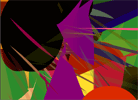
Kandinsky’s art has never really been my cup of tea. I dig abstract art, but I need a little more prettiness in my abstractness. Kandinsky was more into the sort of deeply angular weirdness that inspired many devoted postmodern followers, and probably a few Yes album covers. (Interestingly, Kandinsky was something of a synesthesiac, and claimed that he saw color when he listened to music.)
Anyway, Robert Peake is both a very cool programmer and a fan of Kandinsky, so he created a virtual-artist artificial-intelligence program that produces Kandinsky-like drawings — including the one above! Just pump in a few variables — how many shapes you want, the size and width of the picture — and it’ll kick out insto-art. His FAQ is a blast to read, and includes this Q&A:
C’mon, isn’t this really just a bunch of random shapes?
Well, yes and no. I have already begun to make aesthetic decisions, like assigning a color palette to the shading and constraining how far the shapes can be flung. Also, the “randomSymphonic” class does something very common in Kandinsky’s work - arranges either 3, 5 or 7 shapes in a vertical pattern. Usually, these look like brush strokes. It’s a start.
So, already the beginnings of human aesthetics are poking their way in to the picture. I’ll need to bear these in mind as a baseline when I start applying more advanced principles. The ultimate goal of this project is to apply and then test (via human feedback) a wide variety of aesthetic principles. Because it is web-native, the potential for getting a large sample size for human data on what “is and is not art” as well as mapping this data to precise heuristics makes this project interesting.
(Thanks to Slashdot for this one!)
I'm Clive Thompson, the author of Smarter Than You Think: How Technology is Changing Our Minds for the Better (Penguin Press). You can order the book now at Amazon, Barnes and Noble, Powells, Indiebound, or through your local bookstore! I'm also a contributing writer for the New York Times Magazine and a columnist for Wired magazine. Email is here or ping me via the antiquated form of AOL IM (pomeranian99).
ECHO
Erik Weissengruber
Vespaboy
Terri Senft
Tom Igoe
El Rey Del Art
Morgan Noel
Maura Johnston
Cori Eckert
Heather Gold
Andrew Hearst
Chris Allbritton
Bret Dawson
Michele Tepper
Sharyn November
Gail Jaitin
Barnaby Marshall
Frankly, I'd Rather Not
The Shifted Librarian
Ryan Bigge
Nick Denton
Howard Sherman's Nuggets
Serial Deviant
Ellen McDermott
Jeff Liu
Marc Kelsey
Chris Shieh
Iron Monkey
Diversions
Rob Toole
Donut Rock City
Ross Judson
Idle Words
J-Walk Blog
The Antic Muse
Tribblescape
Little Things
Jeff Heer
Abstract Dynamics
Snark Market
Plastic Bag
Sensory Impact
Incoming Signals
MemeFirst
MemoryCard
Majikthise
Ludonauts
Boing Boing
Slashdot
Atrios
Smart Mobs
Plastic
Ludology.org
The Feature
Gizmodo
game girl
Mindjack
Techdirt Wireless News
Corante Gaming blog
Corante Social Software blog
ECHO
SciTech Daily
Arts and Letters Daily
Textually.org
BlogPulse
Robots.net
Alan Reiter's Wireless Data Weblog
Brad DeLong
Viral Marketing Blog
Gameblogs
Slashdot Games

