
« PREVIOUS ENTRY
On the road = no entries
NEXT ENTRY »
Can a crowd produce art? My latest Slate column
Dig this: Down in Nigeria, a new urban legend is terrifying mobile-phone users. A list of “killer phone numbers” is circulating around — including 0802 311 1999 and 0802 222 5999 — along with the warning that if you answer a call from one of these numbers, you’ll die immediately. The level of panic is now sufficiently high that the local mobile carrier has been forced to issue an official rebuttal, as News24 reports:
“We wish to state categorically that from an engineering point of view, it is absolutely impracticable, and there is no such record whatsoever anywhere in the world, that anyone has died or can die from merely receiving or making a phone call on GSM or any other telecommunications platform.”
Heh. It’s pretty surreal, obviously, but I can understand how rumors like this get started — because when you think about it for a second, mobile phones (and phones in general) are actually an incredibly creepy technology. I mean, you hold this device to your head and a teleported voice from across the world talks to you? What’s up with that? As Erik Davis pointed out in a 1999 article, the history of telecommunications has been shot through with physic supernaturality:
From the moment that human beings started communicating with electrical and electromagnetic signals, the ether has been a spooky place. Four years after Samuel Morse strung up his first telegraph wire in 1844, two young girls in upstate New York kick-started Spiritualism, a massively popular occult religion which attempted to fuse science and seance. One of the movement’s main newspapers was called “The Celestial Telegraph,” and many of the spirits contacted by mediums were electricity geeks. Totally legit scientists like Thomas Edison, the radiographer Sir Oliver Lodge, and Sir William Crookes (inventor of the cathode ray tube you are probably reading this on) all suspected that spirits were real and that the afterlife was electromagnetic in nature. Edison even built a device to communicate directly with the dead.
(Thanks to Techdirt Wireless News for this one!)
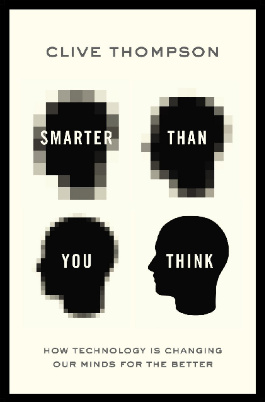
I'm Clive Thompson, the author of Smarter Than You Think: How Technology is Changing Our Minds for the Better (Penguin Press). You can order the book now at Amazon, Barnes and Noble, Powells, Indiebound, or through your local bookstore! I'm also a contributing writer for the New York Times Magazine and a columnist for Wired magazine. Email is here or ping me via the antiquated form of AOL IM (pomeranian99).
ECHO
Erik Weissengruber
Vespaboy
Terri Senft
Tom Igoe
El Rey Del Art
Morgan Noel
Maura Johnston
Cori Eckert
Heather Gold
Andrew Hearst
Chris Allbritton
Bret Dawson
Michele Tepper
Sharyn November
Gail Jaitin
Barnaby Marshall
Frankly, I'd Rather Not
The Shifted Librarian
Ryan Bigge
Nick Denton
Howard Sherman's Nuggets
Serial Deviant
Ellen McDermott
Jeff Liu
Marc Kelsey
Chris Shieh
Iron Monkey
Diversions
Rob Toole
Donut Rock City
Ross Judson
Idle Words
J-Walk Blog
The Antic Muse
Tribblescape
Little Things
Jeff Heer
Abstract Dynamics
Snark Market
Plastic Bag
Sensory Impact
Incoming Signals
MemeFirst
MemoryCard
Majikthise
Ludonauts
Boing Boing
Slashdot
Atrios
Smart Mobs
Plastic
Ludology.org
The Feature
Gizmodo
game girl
Mindjack
Techdirt Wireless News
Corante Gaming blog
Corante Social Software blog
ECHO
SciTech Daily
Arts and Letters Daily
Textually.org
BlogPulse
Robots.net
Alan Reiter's Wireless Data Weblog
Brad DeLong
Viral Marketing Blog
Gameblogs
Slashdot Games

