
« PREVIOUS ENTRY
CNN cites Wikipedia
NEXT ENTRY »
A robot that eats flies
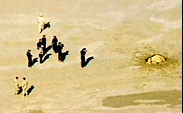
By now, you’ve probably heard the sad news in science: The Genesis probe crashed yesterday. The probe contains samples from solar winds, and the capsule was supposed to have popped out a parachute to slow it down enough that a couple of helicopters could catch it. Instead, it hit the earth at 311 km an hour and buried itself halfway into the ground. Obviously, losing so much good data sucks for scientists, and I’m depressed myself.
Yet as I looked at the pictures of the fallen capsule, I couldn’t help but notice: Don’t they look, rather hilariously, like secret snapshots of a crashed UFO? All those puny humans, huddled uncertainly around the wreckage of superior extraterrestrial technology! It reminds me of what it’d be like if one of our probes ever landed on a planet with sentient life. What in hell would they think of the metal gizmo we’d plunked down on their back yards? Of course, crashes like this also serve to highlight the Andromeda Strain-class importance of our planetary protection protocols, an issue I wrote about several months ago.
NASA has posted a mesmerizing video of the falling capsule online. It looks even more like some crazy samizdat VHS tape of a plummeting alien mission gone terribly awry.
Still, I gotta hand it to NASA: They’re scientists, so when something goes wrong, they don’t try to cover it up. They show you the pictures, they write the press releases glumly concluding that everything went all to hell. It’s another reason I so prefer the culture of science to that of our sneeringly mendacious government administration. If anything goes wrong with the nation, you can count on Bush’s minions to try and hide it. But when something goes wrong in science, researchers immediately trot out the painful evidence. “Sure. Check it out. Here’s a video of our $260-million probe slamming into the earth like a bag of anvils tossed out of heaven.”
I'm Clive Thompson, the author of Smarter Than You Think: How Technology is Changing Our Minds for the Better (Penguin Press). You can order the book now at Amazon, Barnes and Noble, Powells, Indiebound, or through your local bookstore! I'm also a contributing writer for the New York Times Magazine and a columnist for Wired magazine. Email is here or ping me via the antiquated form of AOL IM (pomeranian99).
ECHO
Erik Weissengruber
Vespaboy
Terri Senft
Tom Igoe
El Rey Del Art
Morgan Noel
Maura Johnston
Cori Eckert
Heather Gold
Andrew Hearst
Chris Allbritton
Bret Dawson
Michele Tepper
Sharyn November
Gail Jaitin
Barnaby Marshall
Frankly, I'd Rather Not
The Shifted Librarian
Ryan Bigge
Nick Denton
Howard Sherman's Nuggets
Serial Deviant
Ellen McDermott
Jeff Liu
Marc Kelsey
Chris Shieh
Iron Monkey
Diversions
Rob Toole
Donut Rock City
Ross Judson
Idle Words
J-Walk Blog
The Antic Muse
Tribblescape
Little Things
Jeff Heer
Abstract Dynamics
Snark Market
Plastic Bag
Sensory Impact
Incoming Signals
MemeFirst
MemoryCard
Majikthise
Ludonauts
Boing Boing
Slashdot
Atrios
Smart Mobs
Plastic
Ludology.org
The Feature
Gizmodo
game girl
Mindjack
Techdirt Wireless News
Corante Gaming blog
Corante Social Software blog
ECHO
SciTech Daily
Arts and Letters Daily
Textually.org
BlogPulse
Robots.net
Alan Reiter's Wireless Data Weblog
Brad DeLong
Viral Marketing Blog
Gameblogs
Slashdot Games

