
« PREVIOUS ENTRY
Hydrostatic bipedal movement!
NEXT ENTRY »
“Attention Deficit Trait”
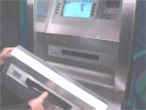
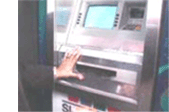
Next time you use a bank machine, check closely to make sure it’s the real thing. Cops in San Francisco report that thieves are now installing fake overlays on banking ATMs. The fakes swallow your card, record your PIN, and report that they’re out of service; the thieves show up later to remove the fake overlay and harvest the cards and collected PINs.
As crimes go, I gotta had it to these scam artists: That takes work. It’s also quite successful, according to a story in last week’s San Francisco Examiner:
Daly City nurse Elaine Flaherty’s ATM card was swallowed at a Washington Mutual bank in the West Portal district March 13, and within hours thieves had milked $4,000 from the card, using it from San Mateo to Los Angeles.
After poking around online a bit, I discovered a fascinating summary written up by Diebold — the leading manufacturer of ATMs — of the latest card-scamming techniques (PDF link). Some of the tricks are pretty low-fi. In some cases, the scam artists put a simple jamming device on the ATM’s card-slot that gets the card stuck inside. Then they put a fake sticker on the ATM saying that “if your card doesn’t work, try typing your PIN again”, which gives the shoulder-surfing thieves a chance to watch and remember it again. When you give up and walk away, they retrieve your card and withdraw all your cash. But some of the cons are more high-tech. In some cases, the criminals also put a fake 12-button keypad over the ATM’s real keypad; their fake records your PIN. And that artificial overlay for the entire machine, pictured above, is the ne plus ultra of this flimflammery.
It occurs to me that one of the reasons the fake overlays work is that real ATMs these days are often so shoddily designed that they already look fake. Sure, the ATMs embedded into the side of banks are usually pretty gleaming and high-tech. But the bank machines you find in crummy corner bodegas, composed of cheap aluminum and early-80s-vintage all-green video displays? Those things look like badly-assembled droids from the first Star Wars. No wonder it’s so easy to dupe banking customers. Using materials I’ve got lying around my kitchen, I could probably create a reasonable facsimile of the ATMs in most Manhattan bagel shops.
(Thanks to El Rey for this one!)
I'm Clive Thompson, the author of Smarter Than You Think: How Technology is Changing Our Minds for the Better (Penguin Press). You can order the book now at Amazon, Barnes and Noble, Powells, Indiebound, or through your local bookstore! I'm also a contributing writer for the New York Times Magazine and a columnist for Wired magazine. Email is here or ping me via the antiquated form of AOL IM (pomeranian99).
ECHO
Erik Weissengruber
Vespaboy
Terri Senft
Tom Igoe
El Rey Del Art
Morgan Noel
Maura Johnston
Cori Eckert
Heather Gold
Andrew Hearst
Chris Allbritton
Bret Dawson
Michele Tepper
Sharyn November
Gail Jaitin
Barnaby Marshall
Frankly, I'd Rather Not
The Shifted Librarian
Ryan Bigge
Nick Denton
Howard Sherman's Nuggets
Serial Deviant
Ellen McDermott
Jeff Liu
Marc Kelsey
Chris Shieh
Iron Monkey
Diversions
Rob Toole
Donut Rock City
Ross Judson
Idle Words
J-Walk Blog
The Antic Muse
Tribblescape
Little Things
Jeff Heer
Abstract Dynamics
Snark Market
Plastic Bag
Sensory Impact
Incoming Signals
MemeFirst
MemoryCard
Majikthise
Ludonauts
Boing Boing
Slashdot
Atrios
Smart Mobs
Plastic
Ludology.org
The Feature
Gizmodo
game girl
Mindjack
Techdirt Wireless News
Corante Gaming blog
Corante Social Software blog
ECHO
SciTech Daily
Arts and Letters Daily
Textually.org
BlogPulse
Robots.net
Alan Reiter's Wireless Data Weblog
Brad DeLong
Viral Marketing Blog
Gameblogs
Slashdot Games

