
« PREVIOUS ENTRY
Porta-vinyl!
Two years ago I wrote a short essay about “ambient information” devices — technologies that, instead of forcing us to stare at a screen, convey their information via quiet cues that we see or feel in the periphery of our concentration. One simple example is an old-school, analog clock; mount one on the wall and you’ll always sort of “know” what time it is, even though you’ll rarely actually look at it. Another favorite example of mine is in AOL Instant Messenger, when someone on my buddy list signs on and there’s the sound of a door creaking open; it’s a lovely, neatly organic acoustic metaphor that lets me know someone in my posse has arrived. The main philosopher of ambient information is David Rose, whose company Ambient Devices created the now-famous Ambient Orb — which sits on your desk and glows different colors depending on, say, whether your stocks are up or down.
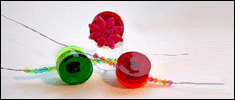
Now here’s an even cooler concept: A bracelet with beads that flash and glow to communicate messages between teenage girls. The beads have lights and sensors embedded in them so a girl can record a message by pressing a sequence of beads, which is broadcast wirelessly to her friends’ bracelets. The designer, Ruth kikin-Gil, created the concept for her master’s thesis, and describes it thusly:
Girl A chooses the type of message she wants to send (for example: I’m talking to the boy we like), records a sequence of presses that conveys her current mood (Excited) and sends it to her friend, which receive the message in her bracelet as a combination of light and vibrations. [snip]
The fact that beads can be added and removed from the bracelet supports the dynamic and flux structures of teenager groups. As the group changes, so does the bracelet’s composition. When two girls are no longer friends, they can remove their friend’s bead from the bracelet and keep it as a memory of their friendship. When they become friends again, few weeks later, the removed beads can be added to the bracelet once again.
I’m not clear on what wireless technology kikin-Gil plans to use; it seems like some sort of bracelet-to-phone-via-Bluetooth setup. Either way, the idea has gorgeous symbolic freight. I’d love to see the sequence of beads teens will use to communicate “best friends forever” vs. “you suck”. If kikin-Gil ever gets these things made, she’ll sell a zillion of them.
(Thanks to Smart Mobs for this one!)
I'm Clive Thompson, the author of Smarter Than You Think: How Technology is Changing Our Minds for the Better (Penguin Press). You can order the book now at Amazon, Barnes and Noble, Powells, Indiebound, or through your local bookstore! I'm also a contributing writer for the New York Times Magazine and a columnist for Wired magazine. Email is here or ping me via the antiquated form of AOL IM (pomeranian99).
ECHO
Erik Weissengruber
Vespaboy
Terri Senft
Tom Igoe
El Rey Del Art
Morgan Noel
Maura Johnston
Cori Eckert
Heather Gold
Andrew Hearst
Chris Allbritton
Bret Dawson
Michele Tepper
Sharyn November
Gail Jaitin
Barnaby Marshall
Frankly, I'd Rather Not
The Shifted Librarian
Ryan Bigge
Nick Denton
Howard Sherman's Nuggets
Serial Deviant
Ellen McDermott
Jeff Liu
Marc Kelsey
Chris Shieh
Iron Monkey
Diversions
Rob Toole
Donut Rock City
Ross Judson
Idle Words
J-Walk Blog
The Antic Muse
Tribblescape
Little Things
Jeff Heer
Abstract Dynamics
Snark Market
Plastic Bag
Sensory Impact
Incoming Signals
MemeFirst
MemoryCard
Majikthise
Ludonauts
Boing Boing
Slashdot
Atrios
Smart Mobs
Plastic
Ludology.org
The Feature
Gizmodo
game girl
Mindjack
Techdirt Wireless News
Corante Gaming blog
Corante Social Software blog
ECHO
SciTech Daily
Arts and Letters Daily
Textually.org
BlogPulse
Robots.net
Alan Reiter's Wireless Data Weblog
Brad DeLong
Viral Marketing Blog
Gameblogs
Slashdot Games

