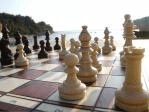
The white knight is talking backwards

Why do so many chess players wind up with severe mental illness? People have long noted connections between madness and a talent for math and logic; in his excellent book Engines of Logic -- a history of the people who brought us conceptual framework of the computer -- Martin Davis discovers that easily half the guys were wildly ill. But in modern times, it's the ravings and antics of Bobby Fischer that pose the question most directly: Did chess trouble his mind, or is it simply that people with troubled minds seek out chess?
Could it be that chess is a palliative? Does someone with that much logical talent literally need chess as a steam-release-valve, or a meditative focus for their brains? British chess Master Bill Hartston once quipped that "chess doesn't drive people mad, it keeps mad people sane". I've spoken with chess masters who describe their mental states in fascinating ways: "The chess pieces eventually just vanish," as one once told me, "and you just see the board in your mind as vectors of force and movement, like the purest geometry ever." He also told me that when he lies in bed he can't get the images out of his head; this causes insomnia, which itself, of course, can trigger depression or manic episodes. Everyone who's played a few hours of Tetris or Halo knows what it's like to have that stuff stuck in your head; imagine how much more intense it is for people who think about chess for hours and hours a day.
This question -- whether the playing of serious chess can loop into a self-reinforcing spiral -- is damn interesting, and Charles Krauthammer, of all people, recently tackled in it a Time column. He notes that while chess requires monomaniacal focus, so do sports like golf, and nobody's worried about Tiger Woods going mad. Then Krauthammer makes his most intriguing points:
Well, then, this must be monomania of a certain sort. Chess is a particularly enclosed, self-referential activity. It's not just that it lacks the fresh air of sport, but that it lacks connections to the real world outside -- a tether to reality enjoyed by the monomaniacal students of other things, say, volcanic ash or the mating habits of the tsetse fly. As Stefan Zweig put it in his classic novella The Royal Game, chess is "thought that leads nowhere, mathematics that add up to nothing, art without an end product, architecture without substance."
But chess has a third -- and unique -- characteristic that is particularly fatal. It is not just monomaniacal and abstract, but its arena is a playing field on which the other guy really is after you. The essence of the game is constant struggle against an adversary who, by whatever means of deception and disguise, is entirely, relentlessly, unfailingly dedicated to your destruction. It is only a board, but it is a field of dreams for paranoia.
Research into the relationship of chess and mental illness will reveal some really cool things about the mind, I predict.
(Thanks to Filter for this one!)
Posted by Clive Thompson at April 29, 2005 11:59 AM
Trackback Pings
TrackBack URL for this entry: http://www.collisiondetection.net/mt3/mt-tb.cgi/1208
Awesome story. In fact, an amazing few days of posts -- from Mandy Amano through Joe Klein. Thank you yet again, Clive!
Posted by: jason at April 29, 2005 1:47 PM
Woo! I think I'm going to have do some paying work now .... heh.
Posted by: Clive at April 29, 2005 2:57 PM
I agree Jason. The posts lately have been frequent and fabulous. It is greatly appreciated, Clive.
Posted by: Steve E. at May 1, 2005 12:06 AM
If you want to see chess-based personalities verring towards insanity in real time, I highly recommend the documentary "Game Over: Kasparov and the Machine". It's centred around the Master's last challenge against Deep Blue, but also covers the broader world of internation chess. With his paranoia and delusions, Kasparov looks like he'll be perfect for his new foray into Russian politics.
Posted by: Sugar at May 1, 2005 4:15 PM
Steve, woo!
Sugar, very cool recommendation -- I think I'd heard someone mention that doc to me too, before. I'm going to see if Netflix has it ...
Posted by: Clive at May 1, 2005 7:13 PM
I'm a gamer. And I'm a chess-hater as well. I know how to play it, but the words used in that piece..self-reinforcing spiral...ring very true. The problem with chess is that it's completly self-contained. It's the same pieces, the same board. Golf, for example, each course is different, natch, each time you play it's different. Different wind conditions and so on. But in chess, there's no other. It's absolutly and completly focused on the here and now.
As well as I'm one of those people mentioned who need an intellectual release valve, chess does the opposite. It plugs it up. Instead of allowing me to get that out, it simply bottles it up. And that creates periods of mania/paranoia/whatever. And because of that, your opponent isn't your rival. He's your enemy. There's a huge different there. It's not even subtle.
I've played other direct head-to-head games. Magic:The Gathering and other CCGs, have played in heads-up board game matches of all types, you name it I've played it. Competitivly as well. Chess is one of the only ones I've found to actually have a negative effect on my psyche. Most other games, competition breeds what is really good-natured fun. Chess? It's war.
Posted by: Karmakin at May 2, 2005 12:28 PM
That is damn interesting to hear, particularly given your competitive experience with other games.
That point about golf having different permutations of physicality is, I think, precisely the vector that separates chess from so many other forms of skull-king mental activity.
Posted by: Clive at May 2, 2005 2:20 PM
This reminds me of the wizard chess scene in Harry Potter and the Philosopher's Stone: "They're out to get me!"
Posted by: Laura at May 3, 2005 2:37 PM
Posted by: Clive at May 3, 2005 11:22 PM
Chess for me has always been just a hobby. I played in chess tournaments when I was a junior in the late 1970's.Thirty years later I again had the opportunity to in tournaments again and noticed something strange, my chess player acqaintances were for the most part disturbed mentally, smelly and perpetually smoking cigarettes! I did read somewhere that playing to much chess can make people delusional, bipolar or obsessive compulsive. This seems to be true.
Posted by: Malejewicz at January 10, 2006 9:58 PM
Post a comment
Awesome story. In fact, an amazing few days of posts -- from Mandy Amano through Joe Klein. Thank you yet again, Clive!
Posted by: jason
at April 29, 2005 1:47 PM
Woo! I think I'm going to have do some paying work now .... heh.
Posted by: Clive
at April 29, 2005 2:57 PM
I agree Jason. The posts lately have been frequent and fabulous. It is greatly appreciated, Clive.
Posted by: Steve E.
at May 1, 2005 12:06 AM
If you want to see chess-based personalities verring towards insanity in real time, I highly recommend the documentary "Game Over: Kasparov and the Machine". It's centred around the Master's last challenge against Deep Blue, but also covers the broader world of internation chess. With his paranoia and delusions, Kasparov looks like he'll be perfect for his new foray into Russian politics.
Posted by: Sugar
at May 1, 2005 4:15 PM
Steve, woo!
Sugar, very cool recommendation -- I think I'd heard someone mention that doc to me too, before. I'm going to see if Netflix has it ...
Posted by: Clive
at May 1, 2005 7:13 PM
I'm a gamer. And I'm a chess-hater as well. I know how to play it, but the words used in that piece..self-reinforcing spiral...ring very true. The problem with chess is that it's completly self-contained. It's the same pieces, the same board. Golf, for example, each course is different, natch, each time you play it's different. Different wind conditions and so on. But in chess, there's no other. It's absolutly and completly focused on the here and now.
As well as I'm one of those people mentioned who need an intellectual release valve, chess does the opposite. It plugs it up. Instead of allowing me to get that out, it simply bottles it up. And that creates periods of mania/paranoia/whatever. And because of that, your opponent isn't your rival. He's your enemy. There's a huge different there. It's not even subtle.
I've played other direct head-to-head games. Magic:The Gathering and other CCGs, have played in heads-up board game matches of all types, you name it I've played it. Competitivly as well. Chess is one of the only ones I've found to actually have a negative effect on my psyche. Most other games, competition breeds what is really good-natured fun. Chess? It's war.
Posted by: Karmakin
at May 2, 2005 12:28 PM
That is damn interesting to hear, particularly given your competitive experience with other games.
That point about golf having different permutations of physicality is, I think, precisely the vector that separates chess from so many other forms of skull-king mental activity.
Posted by: Clive
at May 2, 2005 2:20 PM
This reminds me of the wizard chess scene in Harry Potter and the Philosopher's Stone: "They're out to get me!"
Posted by: Laura
at May 3, 2005 2:37 PM
Ahahaha!
Posted by: Clive
at May 3, 2005 11:22 PM
Chess for me has always been just a hobby. I played in chess tournaments when I was a junior in the late 1970's.Thirty years later I again had the opportunity to in tournaments again and noticed something strange, my chess player acqaintances were for the most part disturbed mentally, smelly and perpetually smoking cigarettes! I did read somewhere that playing to much chess can make people delusional, bipolar or obsessive compulsive. This seems to be true.
Posted by: Malejewicz
at January 10, 2006 9:58 PM