
« PREVIOUS ENTRY
1337 h@x0r 0wnz0rs himself
NEXT ENTRY »
Why fan-based art will rule: My latest Slate column

Why do so many chess players wind up with severe mental illness? People have long noted connections between madness and a talent for math and logic; in his excellent book Engines of Logic — a history of the people who brought us conceptual framework of the computer — Martin Davis discovers that easily half the guys were wildly ill. But in modern times, it’s the ravings and antics of Bobby Fischer that pose the question most directly: Did chess trouble his mind, or is it simply that people with troubled minds seek out chess?
Could it be that chess is a palliative? Does someone with that much logical talent literally need chess as a steam-release-valve, or a meditative focus for their brains? British chess Master Bill Hartston once quipped that “chess doesn’t drive people mad, it keeps mad people sane”. I’ve spoken with chess masters who describe their mental states in fascinating ways: “The chess pieces eventually just vanish,” as one once told me, “and you just see the board in your mind as vectors of force and movement, like the purest geometry ever.” He also told me that when he lies in bed he can’t get the images out of his head; this causes insomnia, which itself, of course, can trigger depression or manic episodes. Everyone who’s played a few hours of Tetris or Halo knows what it’s like to have that stuff stuck in your head; imagine how much more intense it is for people who think about chess for hours and hours a day.
This question — whether the playing of serious chess can loop into a self-reinforcing spiral — is damn interesting, and Charles Krauthammer, of all people, recently tackled in it a Time column. He notes that while chess requires monomaniacal focus, so do sports like golf, and nobody’s worried about Tiger Woods going mad. Then Krauthammer makes his most intriguing points:
Well, then, this must be monomania of a certain sort. Chess is a particularly enclosed, self-referential activity. It’s not just that it lacks the fresh air of sport, but that it lacks connections to the real world outside — a tether to reality enjoyed by the monomaniacal students of other things, say, volcanic ash or the mating habits of the tsetse fly. As Stefan Zweig put it in his classic novella The Royal Game, chess is “thought that leads nowhere, mathematics that add up to nothing, art without an end product, architecture without substance.”
But chess has a third — and unique — characteristic that is particularly fatal. It is not just monomaniacal and abstract, but its arena is a playing field on which the other guy really is after you. The essence of the game is constant struggle against an adversary who, by whatever means of deception and disguise, is entirely, relentlessly, unfailingly dedicated to your destruction. It is only a board, but it is a field of dreams for paranoia.
Research into the relationship of chess and mental illness will reveal some really cool things about the mind, I predict.
(Thanks to Filter for this one!)
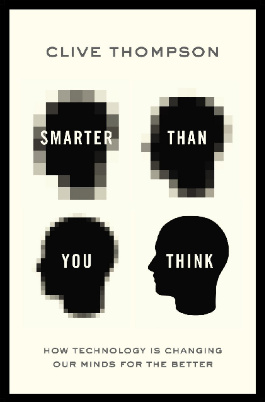
I'm Clive Thompson, the author of Smarter Than You Think: How Technology is Changing Our Minds for the Better (Penguin Press). You can order the book now at Amazon, Barnes and Noble, Powells, Indiebound, or through your local bookstore! I'm also a contributing writer for the New York Times Magazine and a columnist for Wired magazine. Email is here or ping me via the antiquated form of AOL IM (pomeranian99).
ECHO
Erik Weissengruber
Vespaboy
Terri Senft
Tom Igoe
El Rey Del Art
Morgan Noel
Maura Johnston
Cori Eckert
Heather Gold
Andrew Hearst
Chris Allbritton
Bret Dawson
Michele Tepper
Sharyn November
Gail Jaitin
Barnaby Marshall
Frankly, I'd Rather Not
The Shifted Librarian
Ryan Bigge
Nick Denton
Howard Sherman's Nuggets
Serial Deviant
Ellen McDermott
Jeff Liu
Marc Kelsey
Chris Shieh
Iron Monkey
Diversions
Rob Toole
Donut Rock City
Ross Judson
Idle Words
J-Walk Blog
The Antic Muse
Tribblescape
Little Things
Jeff Heer
Abstract Dynamics
Snark Market
Plastic Bag
Sensory Impact
Incoming Signals
MemeFirst
MemoryCard
Majikthise
Ludonauts
Boing Boing
Slashdot
Atrios
Smart Mobs
Plastic
Ludology.org
The Feature
Gizmodo
game girl
Mindjack
Techdirt Wireless News
Corante Gaming blog
Corante Social Software blog
ECHO
SciTech Daily
Arts and Letters Daily
Textually.org
BlogPulse
Robots.net
Alan Reiter's Wireless Data Weblog
Brad DeLong
Viral Marketing Blog
Gameblogs
Slashdot Games

