
« PREVIOUS ENTRY
Watershed: A blog about water
NEXT ENTRY »
“Tag” — the simplest video game in the world
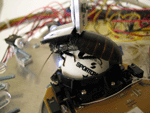
Roboticists constantly argue about how to create the best guidance and collision-avoidance artificial intelligence. Artificial vision is still not all that great, and the algorithms for decision-making — i.e. how the robot chooses which direction to turn around an obstacle — can produce overly predictable behavior. So in December, Garnet Hertz presented a novel solution: A robot that is guided by a cockroach.
Hertz built a four-wheeled robot with a ping-pong ball atop, which functions like a trackball; whatever direction and speed the ball rolls, the robot moves. Then he mounted a giant Madagascar hissing cockroach on top of the ball. When the robot encounters an oncoming object, a light shines on the roach from the corresponding direction, and the roach — which dislikes light, of course — turns to avoid it. This gives the robot a roach-like movement and, hence, a roach-like intelligence.
He’s got a terrific web site showing how it works, but my favorite part is where he addresses the ethics of roach guidance systems:
Is the cockroach in pain?
Madagascan Hissing Cockroaches make a loud “alert hiss” when they are angry. They also enjoy feel safe when crammed into a tight space. Their cuticle has no nerve endings in it. Because of these reasons, and because they do not illustrate a fearful hiss when controlling the robot, it is my opinion that they are in no pain, and do not mind being in the robot system.It looks like the cockroach is being crushed when it is controlling the robot — is this so?
No. If you get down to the eye level of the insect, you can see that the foot-to-ground relationship of the cockroach to the trackball is very similar to a standard cockroach gait. That is, if you know what a standard cockroach gait looks like. And another thing: cockroaches appear to feel comforted and safe when they are slightly crushed. The native habitat of Madagascan Hissing Cockroaches is the forest floor; as a result, cramming underneath an object/leaf is an instinctively safe place. People tend to like open spaces, cockroaches tend to like confined spaces.
I'm Clive Thompson, the author of Smarter Than You Think: How Technology is Changing Our Minds for the Better (Penguin Press). You can order the book now at Amazon, Barnes and Noble, Powells, Indiebound, or through your local bookstore! I'm also a contributing writer for the New York Times Magazine and a columnist for Wired magazine. Email is here or ping me via the antiquated form of AOL IM (pomeranian99).
ECHO
Erik Weissengruber
Vespaboy
Terri Senft
Tom Igoe
El Rey Del Art
Morgan Noel
Maura Johnston
Cori Eckert
Heather Gold
Andrew Hearst
Chris Allbritton
Bret Dawson
Michele Tepper
Sharyn November
Gail Jaitin
Barnaby Marshall
Frankly, I'd Rather Not
The Shifted Librarian
Ryan Bigge
Nick Denton
Howard Sherman's Nuggets
Serial Deviant
Ellen McDermott
Jeff Liu
Marc Kelsey
Chris Shieh
Iron Monkey
Diversions
Rob Toole
Donut Rock City
Ross Judson
Idle Words
J-Walk Blog
The Antic Muse
Tribblescape
Little Things
Jeff Heer
Abstract Dynamics
Snark Market
Plastic Bag
Sensory Impact
Incoming Signals
MemeFirst
MemoryCard
Majikthise
Ludonauts
Boing Boing
Slashdot
Atrios
Smart Mobs
Plastic
Ludology.org
The Feature
Gizmodo
game girl
Mindjack
Techdirt Wireless News
Corante Gaming blog
Corante Social Software blog
ECHO
SciTech Daily
Arts and Letters Daily
Textually.org
BlogPulse
Robots.net
Alan Reiter's Wireless Data Weblog
Brad DeLong
Viral Marketing Blog
Gameblogs
Slashdot Games

