
« PREVIOUS ENTRY
Francis Crick, deadhead
NEXT ENTRY »
The ultimate sponge
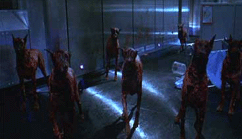
A handful of scientists have just created the world’s first successful zombie dogs — canines that, after being dead for three hours, are brought back from the sweet hereafter. The experiment, spearheaded by Dr. Patrick Kochanek, works like this: The scientists drain the dogs of all blood, and replace it with saline solution chilled to a few degrees above zero. The temperature of the dogs’ bodies drops to 7 degrees celsius; they die of hypothermia first, and when the transfusion is complete, the cold saline preserves their organs from decay.
To bring them back to life, the scientists return the blood to their bodies, surround them with an atmosphere of 100 per cent oxygen, and — in a detail that couldn’t be more Frankensteinian — use electric shocks to restart their hearts.
The research is quite important, because the scientists eventually hope to create techniques allowing critically-ill patients — such as battlefield soldiers — to be preserved in a safe state of suspended animation for hours while being transported to a suitable hospital. But let’s face it: The mere details of these experiments are so inherently ghoulish that animal-rights advocates were pretty much guaranteed to object, as the New York Post reports:
Mary Beth Sweetland, a spokeswoman for People for the Ethical Treatment of Animals, said: “These experiments are indefensible nonsense and the results for humans will be negligible. I would also imagine there are serious consequences for these animals that aren’t discussed.”
Woof. It probably doesn’t help that Kochanek’s research group is called the Safar Center for Resuscitation Research — a name with positively comic-book qualities — or that games like Resident Evil have long included killer zombie dogs.
I'm Clive Thompson, the author of Smarter Than You Think: How Technology is Changing Our Minds for the Better (Penguin Press). You can order the book now at Amazon, Barnes and Noble, Powells, Indiebound, or through your local bookstore! I'm also a contributing writer for the New York Times Magazine and a columnist for Wired magazine. Email is here or ping me via the antiquated form of AOL IM (pomeranian99).
ECHO
Erik Weissengruber
Vespaboy
Terri Senft
Tom Igoe
El Rey Del Art
Morgan Noel
Maura Johnston
Cori Eckert
Heather Gold
Andrew Hearst
Chris Allbritton
Bret Dawson
Michele Tepper
Sharyn November
Gail Jaitin
Barnaby Marshall
Frankly, I'd Rather Not
The Shifted Librarian
Ryan Bigge
Nick Denton
Howard Sherman's Nuggets
Serial Deviant
Ellen McDermott
Jeff Liu
Marc Kelsey
Chris Shieh
Iron Monkey
Diversions
Rob Toole
Donut Rock City
Ross Judson
Idle Words
J-Walk Blog
The Antic Muse
Tribblescape
Little Things
Jeff Heer
Abstract Dynamics
Snark Market
Plastic Bag
Sensory Impact
Incoming Signals
MemeFirst
MemoryCard
Majikthise
Ludonauts
Boing Boing
Slashdot
Atrios
Smart Mobs
Plastic
Ludology.org
The Feature
Gizmodo
game girl
Mindjack
Techdirt Wireless News
Corante Gaming blog
Corante Social Software blog
ECHO
SciTech Daily
Arts and Letters Daily
Textually.org
BlogPulse
Robots.net
Alan Reiter's Wireless Data Weblog
Brad DeLong
Viral Marketing Blog
Gameblogs
Slashdot Games

